Category: empowerment

  • Wellness rooms in the workplace: do they work?  Here’s how they could

    Wellness rooms in the workplace: do they work? Here’s how they could

    Modern office wellness rooms aim to support employee wellbeing but often fall short due to stigma, poor design, and limited use. Effective wellness spaces should prioritise privacy, comfort, and sensory experiences. A supportive corporate culture is essential, while dedicated attention to design can enhance these rooms, making them truly beneficial for employees.

    Real wellbeing or a box ticking exercise?

    Many modern office buildings incorporate ‘wellness’ rooms – places where office workers can go and decompress for a little while if stressed, overwhelmed or just in need of a few minutes of freedom from an annoying colleague or frustrating boss.

    These spaces are often quite small, sited away from the main office space and often never used. They can allow HR departments to claim that they take employee wellbeing seriously and they might even result in a tick in box on wellbeing rating checklist or a favourable comment on Glassdoor, LinkedIn or a job board.

    There are many reasons why they might not used.

    • They can be hard to find
    • They might be uncomfortable or poorly designed
    • They might double up as places for other activities, such as prayer. This might make some people worry about breaking a taboo by using them for other purposes, or worry about when the room might not be available
    • Their use might carry a stigma.

    It is the last point that really needs addressing.

    If someone is absent from their desk and their manager asks where they are, going to the wellness room can be seen as sign of weakness.

    Or laziness.

    When wellness rooms are nicknamed ‘Crying Rooms’, which I have come across, then it is clear that there is something wrong with the culture of the organization. When the privacy of a wellness room actually makes you more noticeable – because you are not where you are expected to be – then it isn’t really a private space.

    So, what is the solution?

    The most obvious solution is to ensure that the workplace is civilized. This means creating a corporate culture based on great leadership, trust and autonomy. Good corporate culture has the single biggest influence on psychological comfort and wellbeing.

    However, even in organizations with great culture, there may be situations when one might need to retreat to a space like a wellness room to decompress, recover from overwhelm, physically relax or to meditate for a few minutes.

    So, how can we ensure that such spaces actually foster wellbeing rather than just pay lip service to the concept?

    It’s all about the senses

    I have written before that biophilia is not just an airy-fairy concept, but is rooted in our evolutionary history. When we have a coherent sensory experience, we feel physically and psychologically more comfortable.

    A wellness room needs to be able to satisfy as many, or as few, sensory needs as the user desires. These include:

    Privacy

    Your use of a wellness room should be absolutely private (with some caveats: for some people, the sound of a heavy door closing and locking can evoke memories of trauma).

    You should not have to advertise your use of a space like this, whether by booking a time slot, seeking permission from a manager or even walking past a group of colleagues sitting near its location.

    Furthermore, it must be completely enclosed and prevent any views in from inside the building. Solid doors and walls are essential, and the only windows should be to the outside world. Any windows to the outside should be clear. Some views can be relaxing and being able to focus on distant objects might relieve eye strain as well, but they must be capable of being obscured to prevent the user being seen if that is what is wanted.

    Light, translucent materials, such as voile curtains would allow light in, whilst maintaining privacy. Their graceful, floaty form also provides some textural and visual interest.

    An a.i.-generated image of a possible ideal wellness room, featuring muted colours, natural materials, plants, appropriate furnishings, a moss panel on one wall, a textured rug made of natural fibres and a window partially obscured with a voile curtain.  There is diffuse lighting and a ceiling fan with wooden blades

    Space

    Wellness rooms are often small. They may have been converted from spaces such as small meeting rooms, a small private office or even a storeroom. This is understandable – floorspace can be very expensive, and must be productive. However, happy, healthy workers perform better and are likely to have greater job satisfaction. This means an investment in proper wellness rooms can make sense.

    The space needs to be large enough to allow activities such as light exercise (such as yoga or other low impact activities), and also not be claustrophobic. The idea is to allow relaxation and decompression.

    Some people may wish to lie down, so a clear floor area would be a good idea. There also needs to be space for a comfortable chair, or even a small sofa and maybe some other small items of furniture to give the room a lived-in feel.

    Ceiling height should also be considered. Too low and you risk feeling cramped, or might not be able to stretch upwards. Too high, and it might lose the feeling of intimacy and cosiness that some might be seeking.

    A wellness room with a floor area of approximately 3m X 4m would provide enough space to carry out light exercise, such as stretches or yoga, without being so big that it would compromise the feeling of shelter and cosiness.

    Lighting

    Light should be indirect and controllable – in terms of brightness and also quality. Lighting that includes far red / near infrared wavelengths are thought to have therapeutic benefits, and slightly warmer tones can be calming.

    Placing luminaires so that they wash the walls and ceiling with light, rather than having a point source, will be more relaxing. The use of artificial skylights could also be considered.

    Decorative lighting might also be considered. Whilst real flames would not be appropriate, simulated flames from LED candles, for example, can provide some non-rhythmic visual interest. Similarly, the placement of objects and foliage in front of light sources might cast some interesting shadows.

    Sounds

    Noise from outside should be prevented as far as is practicable, and noise generated from within the wellness room should not be audible outside. This has as much to do with privacy as annoyance and distractions.

    Features such as soft furnishings, moss panels and even foliage plants can be effective at reducing noise levels.

    Sound can be added to the space. They can be used creatively to mask outside noises or even simulate natural sounds such as water, wind in the trees or birdsong. There are many synthetic biophilic sounds available to play through a smart speaker or even download onto a smart phone. One of my favourites is Noises Online, which has 30 individual sounds that can be combined.

    Screenshot of the Noises Online web site showing three sounds combined

    Smells

    Ambient scenting systems are ideal to create subtle scent experiences. These are programmable and have a wide range of fragrances are available. However, care must be taken to ensure that the intensity of the scent is low – especially if the room is not used often and there are few air changes.

    Reed diffusers are a cut-price way of filling a space with scent, but if the room is infrequently used, then the effect may be too intense, and cannot be ‘switched off’.

    Neutral naturalistic fragrances are ideal. Bear in mind that some people are more sensitive to scents than others, so it must be possible to have a scent-free environment if possible.

    Temperature control

    This is likely to be quite difficult to manage – it depends on how the building’s environmental controls are operated and whether room-level control is possible. Radiant heat from underfloor heating is likely to be very comfortable for users of a wellness room – far better than warm air being blown around the space, which may result in uncomfortable draughts.

    Having said that, sometimes gentle airflow, which mimics natural environments, can bring another non-rhythmic element into the space. A ceiling fan – which is controllable by the user – would be sensible addition to the space.

    Textures

    Textures offer both visible and tactile interest. A textured rug, made from fibres such as sisal or jute, can stimulate the touch sensors in bare feet, and features such as a moss panel, tree bark or even a small soapstone ornament can feel good in the hands. Having some tactile ornaments to handle, as well as surfaces, to touch can be very enriching.

    Furniture and accessories

    A wellness room should not be cluttered, and floor space should be kept clear, but it must feel like home. Well chosen furniture and accessories might include:

    • A sofa or couch, possibly in a chaise longue style, to enable the user to sit or lie down
    • A small table, where the user can place a drink. This could also be where some LED candles could be placed
    • A large, soft, textured rug in the centre of the floor. Natural fibres, such as jute or sisal look very naturalistic and also have a nice texture
    • Shelves or a wall-mounted cabinet where ornaments or books can be placed. This can also be where items such as towels or exercise mats can be stored or where bottled water can be kept
    • Somewhere to hang clothes, place shoes and store bags out of the way
    A close-up photograph (by the author) of preserved mosses and lichens mounted in a panel attached to a wall

    The nature connection

    A selection of well-chosen interior plants would be essential. Plants that tolerate low light levels and intermittent lighting would be ideal. They should have a variety of forms, textures and shades of green.

    A panel of preserved moss on one wall would also be ideal. These require little maintenance and have excellent acoustic and tactile benefits.

    Indoor greenery, in all its forms, is my particular area of expertise, so get in touch for advice on this and for recommendations for a detailed specification and maintenance plan.

    … and how to reduce sensory overload

    For some people, especially some autistic people, sensory overload can be debilitating. The ability to access and make use of a quiet, calm, low-stimulus environment can be very helpful

    This means that control of the environment is essential. Being able to turn certain features on or off, or being able to do particular activities to suit individual needs is very important.

    Provision for neurodiversity

    The recently published design guidance: PAS 6463:2022 Design for the mind – Neurodiversity and the built environment provides excellent information for designers on how to create spaces that are accessible for individuals who may not be neurotypical.

    Image of the cover page of PAS 6463: 2022 Guidance book called "Design for the mind - Neurodiversity and Built Environment"

    Chapter 14: Safety, recovery and quiet spaces of the guide is especially relevant in the context of this article as it directly addresses the sensory environment.

    The key takeaway is to give the user of the space as much control over it as possible, but where that is not possible, to design with hypersensitivity in mind – where spaces are as calming and quiet. It says…

    Where only one quiet and restorative space or room is provided, it should be designed as a flexible environment with a variety of design options that are customizable to the individual’s sensory needs.

    Each design aspect should have both low and high stimuli options to accommodate both hypersensitive and hyposensitive needs. In mainstream environments where only one space is provided, it should be designed as a low stimuli quiet space with higher stimuli optional additions by choice.

    If multiple spaces are available, several spaces of various levels of stimuli should be taken into account.

    When creating sensory or quiet spaces, the context of how the spaces are designed and the potential needs of the users should influence the design choices. If a facility is highly stimulating and busy, more than one space should be provided – quantity, quality and location should be taken into account.

  • How do you know whether a design is going to be (or has been) successful? A simple guide to evidence based design

    How do you know whether a design is going to be (or has been) successful? A simple guide to evidence based design

    Evidence-based design (EBD) emphasizes designing spaces based on measurable evidence rather than intuition. Originating in healthcare, EBD applies principles that focus on understanding client goals and developing relevant metrics. Engaging end-users throughout the design process enhances outcomes. By utilizing continuous data analysis, EBD aims to create efficient and user-centric environments.

    What is evidence-based design?

    Evidence-based design (EBD) is the design of spaces based on evidence, not simple ‘rules of thumb’ (also referred to as heuristics). The discipline of EBD was first developed in the healthcare industry, and its principles are increasingly being applied across the built environment.

    An important part of the design process has to be a real understanding of what the client is really trying to achieve and then develop some metrics and indicators to determine whether those objectives have been achieved.

    For example, is the client concerned about health and wellbeing, colleague engagement or productivity? These can all be measured, to an extent.

    Some measurements may be physical or observational, e.g. how space is used. Other measurements might be associated with HR indicators such as absenteeism or complaints about the indoor air quality.

    Maybe, the client is mainly interested in achieving a building certification (such as WELL) or a high Glassdoor rating in order to attract and retain staff (or to gain a “great place to work” recognition). These may require a different set of metrics and, in some cases, might be achieved by ticking boxes and completing spreadsheets without needing to engage with the end-users of the space at all. 

    Having said that, such a workplace, whilst meeting the specified end point of getting a certification, may not be especially effective. It is now well known that empowered, involved and engaged workers tend to be happier, healthier, more satisfied and more productive than those for whom a change was imposed.

    However, without defining terms at the beginning of a project, the designer cannot really justify claims for its subsequent success. Objectives and KPIs must be clearly defined. If not, the wrong metrics may be used. Without good evidence, knowing what tweaks might be needed is impossible. This is especially true once a new workplace design has been commissioned to keep it working effectively.

    If EBD is applied without direct involvement from the end-users, the designer limits the amount and quality of evidence available.

    Five-step approach to evidence-based guided design

    Diagram showing the 5-step evidence-based design process

    I will illustrate the process using an example of creating an new interior landscape scheme in an office-based workplace, although the principles would apply to almost any types of design project. Get in touch to discuss your specific needs.

    Step 1: setting the intent and identifying needs

    Here, we state the intent of the exercise. We seek to discover the needs of the client and identify any issues or areas that are important to the organization. These may relate to health and well being, productivity / financial indicators, staff engagement or even sustainability. Initial discussions would probably be with the client’s management team. It would be wise to also engage informally with the premises users at this time. This helps see if the management’s concerns align with those of their staff.

    Outputs: KPIs agreed, scope and boundaries of surveys agreed, communications plan, workshops and end-user communications (e.g. newsletters)

    Step 2: surveys and initial data

    The next step would be to carry out a detailed set of surveys. This will include an assessment of the physical space (light, noise, layout, air quality, etc.) and a tailor-made staff survey, which will identify and quantify areas of concern. I can design these surveys for you so you get the information you really need.

    The designer would also ensure that we have some objective baseline data from the client (if required) that could be compared against the designer’s own findings.

    Outputs: initial surveys and data analysis, second staff communications, scope and boundaries of design agreed, design budget agreed.

    Step 3: consultation and engagement

    Before any intervention is made (for example, a redesign of the office space), the office staff should be kept engaged.

    Research has demonstrated that giving office workers a genuine stake in the project (hearing their views and giving them real choices) results in better, and more durable, outcomes.

    Throughout the process, the designer would ensure that all stakeholders in the project are kept informed of the progress of the project. This will be achieved using newsletters, social media and face-to-face discussions. At this point, the designer would have a fair idea of options available.

    Outputs: ideas and requests collected from client’s staff, third staff communications

    Step 4: design

    At this point, an experienced design team would be brought in to discuss design options with all the stakeholders. The designer will have an idea of what might work after reviewing all the initial survey information. The designer will then present some outline options to the client.

    The designer would then take their collected ideas forward for discussion and engage all users of the office space in the final decision. Once this has been agreed, the design team would make arrangements for the space to be redesigned accordingly.

    Throughout this process, it is important to keep all stakeholders informed. There is often a few weeks lead time for a design to be installed. The designer and the client need to keep everyone’s enthusiasm alive. They should build up to the day when their ideas are realized in their newly-designed work space.

    Outputs: first design proposals for discussion by staff and management. Revisions and final design choices. Design specification and order. Fourth (and possibly fifth) staff newsletter. Design installation.

    Step 5: Follow-up and continuous review

    The client will need to know whether the interventions carried out in the offices have been successful. Therefore, a series of follow-up surveys could be carried out shortly after the new designs have been installed. These surveys could include staff questionnaires, analysis of the client’s data, and physical measurements of the environment.

    Such surveys might be repeated every 2 months or so for at least 9 months to confirm that the interventions have had a durable effect. If necessary, designs could be reviewed and adjusted as needed to satisfy the customer or end-users. Their experience may highlight unforeseen needs.

    Again, the designer would continue to communicate and engage with all stakeholders to let them know what is going on, and to get some qualitative evidence as well as quantitative data.

    Outputs: follow-up surveys, data analysis, continuing staff newsletters

    How will you know whether an environment is successful?

    At each step of the process, data will be gathered to determine whether process is working. Data for evidence-based design can come from direct, indirect or proxy sources.

    Pre-interventionAt installationPost intervention
    Direct measures (examples)
    End-user surveys
    End-user focus groups
    Sentiment / satisfaction measures
    Customer interviews
    Observational data
    Sensors and monitors
    Discussions with end users – confirm needs have been met
    Discussions with customer – confirm needs have been met
    Sentiment / satisfaction measures

    Ongoing Post intervention surveys (every few months for at least one year)
    Ongoing sentiment / satisfaction measures
    Interviews and focus groups
    Observational data
    Sensors and monitors
    Indirect measures (examples)
    WELL scorecard
    Fitwel scorecard
    RESET scorecard
    Sustainability scorecard
    Leesman index
    Revenue / person
    Revenue / square foot
    Absenteeism records
    Staff retention rates
    Review sites (e.g. Glassdoor, Trustpilot, etc.)
    Absenteeism records
    Staff retention rates
    Review sites (e.g. Glassdoor, Trustpilot, etc.)


    WELL scorecard
    Fitwel scorecard
    RESET scorecard
    Sustainability scorecard
    Leesman index
    Revenue / person
    Revenue / square foot
    Absenteeism records
    Staff retention rates
    Review sites (e.g. Glassdoor, Trustpilot, etc.)
    Proxy measures (examples)
    Tests and quizzes
    Simulations
    Comparison with similar organizations (impact seen with them probably similar to impact on us)
    Case studies
    References
    Tests and quizzes
    Simulations
    Designer feedback


    Tests and quizzes
    Simulations
    Comparison with similar organizations (impact seen with them probably similar to impact on us)

    Big Brother is watching you

    Direct sources of data may be from automated systems and sensors. Sensors are increasingly being used to give building managers and space planners real-time data on how space is used and the environmental conditions in different parts of a building. This is becoming increasingly important now that hybrid ways of working are becoming more common and workplace usage patterns are changing rapidly.

    Data collected on environmental and space utilization parameters allows for rapid changes in layout or environmental management. This ensures that users get as comfortable and as useful a workspace as possible.

    Mapping survey data to culture, demographics and location: unveiling the nuances

    Understanding the collective preferences of the end users of the workplace – the office workers – is crucial. However, digging deeper into the data is essential. Attempting to map these preferences onto the cultural, demographic, and locational peculiarities of the organization can give invaluable insights. This reveals patterns and nuances that can be easily overlooked in broader surveys.

    The benefits of longitudinal studies

    Collecting survey data immediately before and after the installation of a new interior design is not especially valuable. People notice the immediate impact of change. However, tracking individual responses over time (whilst meticulously maintaining privacy) is very beneficial. It includes collecting data for an extended period post-intervention. This allows the designer to distinguish the subtle effects of design interventions from the larger waves of, say, a new CEO or a major business shift.

    Granular analysis of data over time, ideally with the aid of a statistician, can offer a clear picture. It will reduce the risk of misinterpretations and helps to ensure that design decisions are informed by the most accurate trends.

    Longitudinal studies, with frequent data analysis, also allow for post-design tweaks. Whilst easy-to-digest broad data can be appealing, the detail is where hidden gems of insight can be found.

    Hidden gems

    Demographic studies can hold surprising potential, as long as you know what to look for. For example, a seemingly innocuous study (carried out in the late 1990s) into the plant preferences of staff in a local government office revealed a hidden layer of cultural influence. The headline findings clearly showed a relationship between plant preference and the seniority of the office worker. Closer examination unearthed a deeper connection to gender, rooted in the organization’s history and norms. Men occupied the bulk of the senior positions, whilst there were far more women occupying more junior roles. This highlights the importance of not solely relying on surface-level observations and instead delving into the details woven into the data.

    Another small study challenged preconceived notions by demonstrating that job role, regardless of age, could be a stronger reflector of plant preferences than previously thought. Stereotypes, both reinforced and shattered, illustrate the power of data to illuminate the complexities of human behaviour within a specific context.

    Ultimately, mapping data to culture, demographics, and location is not about finding definitive answers, but rather about uncovering the rich tapestry of influences that shape how people interact with their environment. By exploring the nuances found in data, evidence-based design transcends mere aesthetics and can be a tool that transforms workplaces into spaces that truly resonate with their users.

    Measuring the right thing!

    If the aim of a project is to improve employee wellbeing, then there is no point in measuring the organization’s Net Promoter Score. Likewise, measuring indoor air quality is unlikely to tell you much about a company’s brand reputation.

    Having said that, there are likely to be some interesting interactions. Improving indoor air quality may well have an impact on productivity, especially if carbon dioxide levels are kept low, leading to greater alertness and less fatigue. However, you won’t know if productivity has been improved unless you actually measure it. Similarly, whilst improving employee wellbeing may lead to a better NPS score – happy staff are probably going to give better customer service after all – NPS isn’t, on its own, going to be a reliable measure of wellbeing.

    Here are some possible aims of a design interventions with some of the metrics that could be used.

    Project aimPossible metrics
    Improved productivity
    Revenue (or profit) per employee
    Revenue (or profit) per unit area of office space
    Reduced absenteeismWork days lost, long term absence, etc.
    Increased office space utilization

    Time spent in the office
    Workspace occupancy
    Sensor data
    Improved wellbeing

    Survey data: complaints of SBS, symptoms, reasons for absenteeism, etc.
    Health monitoring data
    Improved environmental quality

    Survey data: workplace comfort
    Physical data: temperature, RH, noise, VOCs, CO2
    Enhanced brand reputation

    NPS data
    Ranking in reviews / indices (e.g. Glassdoor, Leesman, Trustpilot, etc.)
    Improved colleague engagement
    Staff engagement surveys, e.g. Q10, Hays Group,
    Improved customer engagement


    NPS
    Customer comments and complaints, reviews, etc.
    Customer satisfaction surveys
    Trip Advisor scores (for hospitality sector)
    Trustpilot scores (for service providers, retail, etc.)
    Increased footfall or dwell time (retail sector)
    Increase in return custom (retail, healthcare and hospitality)
    Customer referrals (retail, healthcare, hospitality)
    Improved sustainability

    GHG emissions normalized against revenue or per capita (rather than against floor space)
    Reductions in energy costs

    Add value to your interior design

    If you are involved in design, consider an evidence-based approach. This is especially important if you are an interior landscaper who wants to add value to your service. If you need help in putting together a programme, or if you need assistance designing surveys and other elements of data collection, then please get in touch. Check out my services page for information about my specific areas of expertise and consultancy.

    ← Back

    Thank you for your response. ✨

  • Where do you have your best ideas?

    Where do you have your best ideas?

    Human beings are a uniquely creative species, and we are able to gain inspiration from the most unexpected places. And whilst variety and a wide range of work settings now found in modern offices are to be welcomed (management permitting, of course), confining ourselves to one space for work isn’t going to be enough to unleash inspiration and creativity.

    Isaac Newton's garden in Lincolnshire showing the famous apple tree which inspired his theories of gravity
    Isaac Newton’s garden at Woolsthorpe Manor, Lincolnshire

    Did Isaac Newton contemplate the laws of gravity in meeting room 13N.21? No, of course not – he was famously in his garden in Lincolnshire.

    What about Barnes Wallis? The idea of the Bouncing Bomb (of Dambusters fame) didn’t happen in a ‘collaboration zone’, but when skimming a stone across a lake. And Darwin didn’t come up with his theories of evolution in the confines of a meeting pod – his gardens at Down House, in Kent were his place of contemplation.

    The poetry of Wordsworth wasn’t written as a result of sitting at a hot desk in a downtown office block, Hippocrates contemplated his theories of medicine sitting under a tree in the market place of Kos, and Archimedes had his eureka moment whilst having a bath.

    There are innumerable examples of new ideas being inspired by something an inventor, philosopher, author or artist encountered outside of what we now regard as the workplace. Yet, if we were to believe the social media posts of commercial interior designers, or the marketing spin of companies boasting about how they have reimagined the workplace, you might think that we are entering a new golden age of discovery through the medium of office design.

    We are certainly seeing more technology and a much wider range of space types inside office buildings (often supposedly to foster a sense of collaboration and creativity), and there is certainly a greater understanding of the principles and benefits (if not the application) of biophilic design.

    The benefits of biophilic design in the workplace are becoming mainstream. The idea that bringing a sense of nature into our workplaces to support wellbeing and improve organizational outcomes is supported by a growing body of research, much of which has been referenced in some of my previous posts, and it is certainly true that you are more likely to be creative in a well designed, nature-inspired office space than in a sleek, bleak monochrome box.

    Open plan office space
    A creative space?

    It is interesting to note that in many businesses, there is a lot of ‘do as I say, not as I do’ attitudes from business leaders. As an office worker, you may be expected to be seen in the office and to make use of the investments made in design, but leadership ‘retreats’, often in nice country houses or rural resorts, are still common. They are justified on the grounds that such places, away from the distractions of the office (and annoying colleagues), are ideal for strategizing and creativity.

    There are many good reasons why that might be true: I have written about why meeting rooms might not be so great for making important decisions because the elevated carbon dioxide levels found in such spaces can cause drowsiness and affect cognitive ability. Being away from distractions (or allowing yourself to be distracted by something divorced from normal work activities) is also great for thinking, and you never know where you might find inspiration. Being outdoors can certainly help – separating yourself from sources of stress and discomfort, and stimulating your senses by immersing yourself in fresh air and the sights, sounds and smells of nature can be inspiring.

    Needless to say, hiring a resort is never going to be a cost effective solution to the needs of day-to-day creativity and imagination, but there are things you can do.

    View of a lake and trees
    A good place to think
    • Go for a walk. Even if you work in an urban area, a short walk in the neighbourhood can be a useful break from the distractions of the office. In the UK, most people can get so some sort of green space within a few minutes.
    • Whilst you are on your walk, look around and look up – and take out your earphones.
    • Outdoor meetings are also worth trying. Again, the conscious act of taking yourself and colleagues away from the office gives space to think without fear of interruption.
    • If you work from home and have a garden, that is a good place for thinking time, or even for taking a coffee break.

    Human beings are a uniquely creative species, and we are able to gain inspiration from the most unexpected places. And whilst variety and a wide range of work settings now found in modern offices are to be welcomed (management permitting, of course), confining ourselves to one space for work isn’t going to be enough to unleash inspiration and creativity.

  • Office plants when offices are empty?  How interior landscapers can adapt to a rapidly evolving workplace environment

    Office plants when offices are empty?  How interior landscapers can adapt to a rapidly evolving workplace environment

    The pandemic led to accelerated changes in office work and design, leading to a rise in hybrid working and a shift towards more flexible workspaces. With UK office occupancy rates down to 29%, B2B service providers, especially in interior landscaping, face challenges. However, opportunities exist in alternative spaces like co-working venues, necessitating a focus on wellbeing in home offices and other non-traditional workspaces.

    Even before the pandemic, the nature of office work was changing.  There was an increasing shift to creating more purpose-based workspaces that accommodated different styles of activity, such as collaborative working or quiet focused work.  This also led to an increase in the use of non-allocated desks (let alone private offices), so there was no guarantee, or expectation, that an office user would be at the same desk every hour of every day.

    Then, the pandemic forced huge numbers of office workers to work from home, and many of them found it preferable.  This has led to a rise in hybrid working, but has also acted as a catalyst for evolution of workplace design.  

    A decade’s-worth of change seems to have happened in about 18 months and many employers have completely remodelled their office space as a result: partly to attract workers back to the office by making them more comfortable and homely, and partly to adapt them to new ways of working.  

    However, with all the changes in workspace design, many offices are still less than half full for several days a week.  A recent report quoted in The Guardian suggests that the Monday to Friday office occupancy rate across the UK is 29% for the first three months of 2023, and slightly less in London, compared with typical pre-pandemic levels of 60%-80% (according to data from Remit Consulting).  

    Empty open-plan office
    Where is everyone?

    As a result of this, it is quite likely that suppliers of business-to-business (B2B) services are going to be impacted.  Those companies selling discretionary B2B services, such as interior landscaping (my area of interest), are probably going to be especially exposed. 

    B2B companies that already have a nicely diverse mix of customers in terms of sector, size, and geography are probably going to be able to absorb some of the possible shocks, for reasons I’ll discuss later. However, those that are heavily dependent on one part of the marketplace, such as  large corporate offices, might find themselves living in ‘interesting times.’  This is especially true where B2B service providers are not a directly-employed contractor, but appointed by a facilities management company.

    What does this mean for interior landscapers?

    The benefits of interior landscaping and workplace wellbeing are pretty much understood and accepted, so I don’t think there will be a large-scale chuck-out of plants as a cost-saving measure that we have seen in the past (such as the aftermath of the 2008 financial crisis). However, if offices are only – on average – one third full, then it stands to reason that there will be a significant reduction in the floor space needed for organizations.  Those empty floors won’t need plants, art, ambient scenting or coffee machines.

    There is an upside for those businesses agile and imaginative to grasp the opportunities.  Those office workers not commuting as often will still be working somewhere – and not necessarily at home.  They will probably be spending more time working in places such as local co-working venues (several being set up in the suburbs and small satellite towns), coffee shops, or even in hotel lounges.  All of these settings (often called third spaces) would certainly benefit from some nice plants – ideally supplied and maintained by a good interior landscaper.  By offering their services to these spaces, interior landscapers can ensure that their plants continue to be seen and appreciated by workers, even if they are not based in a traditional office environment.

    People working in a coffee shop
    Photo by Marcus Aurelius on Pexels.com

    Employers still have a duty of care

    Even when the workforce is remote, employers still have a responsibility for the health, safety, and wellbeing of all their staff.  It stands to reason that some of those discretionary B2B services could be reimagined as something to enhance wellbeing in the home working environment.

    Many interior plant companies, especially those that have the infrastructure in place to deliver plant displays, could adapt quite quickly – some have already by offering mail order houseplants.  Those companies could easily refine their offer by providing plants that are especially well suited to home working environments.  

    A well-designed home office
    A well-designed home office

    These could include plants that are easy to maintain (and maybe even be set up in such a way as to make plant care especially straightforward), and be properly matched to the home worker’s office environment.  Advice and guidance on selecting the right plants for the space, together with instructions on plant care could be given, alongside tips on how to create a more effective home office space.

  • Indoor air quality in the age of hybrid working: what employers should consider

    Indoor air quality in the age of hybrid working: what employers should consider

    Workspaces are not as full as they used to be and hybrid and remote working is more common and more popular than ever before. Even with incentives (and demands) that people ‘return to the office’, there seems little evidence that office occupancy rates are getting back to pre-pandemic levels any time soon, or even ever. Indeed a recent report quoted in The Guardian suggests that the Monday to Friday office occupancy rate across the UK is 29% for 2023 to date, and slightly less in London, compared with typical pre-pandemic levels of 60%-80% (according to data from Remit Consulting).

    Home workers have needs as well as office workers, and employers have a duty of care to their home-based colleagues as well as those in the office.

    Here we discuss how the pandemic has accelerated the evolution of the workspace and why personal control over the working environment can benefit organizations and workers alike, especially when it comes to the air that we breathe.

    Personal, portable air purifiers and monitors empower workers to maintain a healthy working environment, whether at home or in the office, and give reassurance to employers that they are fulfilling their obligations to ensure that their staff are safe while they are working.

    Accelerated evolution

    Even before the pandemic, the nature of office work was changing. There was an increasing shift to creating more purpose-based workspaces that accommodated different styles of activity, such as collaborative working or quiet focused work. This also led to an increase in the use of non-allocated desks (let alone private offices), so there was no guarantee, or expectation, that an office user would be at the same desk every hour of every day.

    The pandemic forced huge numbers of office workers to work from home, and many of them found it preferable. This has led to a rise in hybrid working, but has also acted as a catalyst for evolution of workplace design. A decade’s-worth of change seems to have happened in about 18 months and many employers have completely remodelled their office space as a result: partly to attract workers back to the office by making them more comfortable and homely, and partly to adapt them to new ways of working. However, with all the improvements in workspace design, many offices are still less than half full for several days a week and those workers that do go to the office are often scattered widely around the place.

    Inviting Big Brother to watch over us

    Another element of our lives that has changed considerably over the last 10 years, and especially rapidly in the last five, is the use of technology to record aspects of our health and wellbeing. The first Apple watch was launched as recently as 2015 and, as well as being a smart timepiece, it can track many aspects of personal health and fitness. The data generated are available for detailed analysis and lifestyle changes can be encouraged.

    Smart watches and smart fitness devices provide a minute-by-minute history of activity and health – including data about health whilst at work. These devices can be used to provide objective evidence of the health of employees in an organization.

    And employers have an obligation to ensure that their employees are working in a safe and healthy environment – wherever they work.

    Other smart, connected devices are also found in the workplace, providing valuable data in real time. These include occupancy sensors and, importantly for wellbeing as well as building management, environmental sensors such as air quality monitors.

    The pandemic also increased awareness of indoor air quality, especially once it was recognized that Covid was transmitted in the air. Air monitoring is a useful tool here. For example, carbon dioxide concentration is a good proxy measurement of ventilation rate – the lower the CO2, the more the air is being refreshed from outside. Higher ventilation rates clearly result in the concentration of airborne pathogens being reduced. However, CO2 is not the only thing worth measuring – increasing ventilation might reduce CO2 and virus concentration, but it could mean bringing in other pollutants from outside, which also need to be measured and controlled.
    Some recent research has shown a relationship between relative humidity, CO2, temperature and virus transmission – this has led to an interesting algorithm that has been deployed on some air monitors that gives an indication of Covid risk(1) (see this Whitepaper, published by RESET).

    Creating wellness instead of fixing problems

    Alongside the development of health and wellness tracking devices, there has been a proliferation of voluntary standards designed to encourage and demonstrate how buildings impact the environment and the people that use them.

    The WELL building standard is one of the best known. It rates a building’s ability to sustain and promote wellbeing across a wide range of parameters. Since launching in 2014, many thousands of buildings around the world have been certified. Other standards include Fitwel and the Living Building Challenge. A very useful comparison of 15 environmental and wellbeing standards can be found here.

    However, these standards primarily relate to how a building works rather than how people work. There is an overlap, but the standards have not yet caught up with hybrid, or completely remote, ways of working.
    How can we know whether our working environment is healthy?

    When offices were predictably occupied, it was very easy to ensure that the working environment met legal and voluntary standards. The environment rarely changed and, if it did, it changed in a predictable and manageable way. Data were collected and facilities managers were able to control the environment of whole buildings from their computer.

    This is still, of course, possible. But the control of whole buildings, or even fixed zones within buildings, is a bit of a blunt instrument when you don’t know where your employees are, when they will be in the building, or what they will be doing whilst they are there. At worst, it means making sure that the whole building is lighted, heated and air-conditioned just in case someone wants to use part of it. This is potentially wasteful of energy and resources.

    Obviously, smart technology, such as occupancy sensors and light sensors can help, but even then, it is often the case that a large zone in a building is ‘switched on’ even if only 20% of the desks are occupied, and the occupiers of those desks scatter themselves as far and wide as possible.

    In these cases, the building provides a safe working environment, even if the resources deployed are used inefficiently and expensively, but how can an organization discharge its health and safety obligations to remote workers – especially those that are new to remote working, or doing work that was previously wholly office based?

    Empowerment

    Over recent years, a lot of interesting research carried out in the UK and The Netherlands(2,3) has demonstrated that empowerment of the working environment yields huge benefits to workers and their employers.

    Data can be very empowering. As discussed earlier, wearable technology and connected devices provide a huge amount of real time data about health and the environment.

    Indoor air quality monitors can be very empowering. If they are visible and showing that there is something not quite right about the air, then the evidence required to make a complaint to the facilities help desk is provided.
    As well as the office worker seeing the data, the facilities help desk should be able to see the same information. Not only that, but there will be a record of the data, so trends can be observed and potential problems identified and fixed quickly.

    Sometimes, people are reluctant to complain, for fear of being regarded as moaners. However, a dispassionate air quality monitor can empower and embolden people to encourage their employers to manage the environment better, or even hand over control, where practical, to the users of the space concerned.
    Where organizations are struggling to retain and recruit, such a visual demonstration of provision of a decent quality working environment is very helpful.

    An air quality monitor might be one way to resolve arguments between facilities managers and building users – the decision to open a window can be validated by an improvement in the particular indoor air quality parameters that mattered to the user at the time.

    This applies to home-based workers as well as those permanently in the office. Although the solution to the problem may not be in the hands of the facilities manager, it can still be facilitated by the employer.

    Taking the solution with you

    Portable, personal air purifiers, such as Vitesy’s Eteria, offer employers and their staff the ability to manage one very important aspect of their working environment – the air they breathe.

    It is a low power personal air purifier that creates a ‘bubble’ of cleaned air around the user, regardless of the size of the room. Instead of cleaning the air in the whole space, it is possible to optimize the quality of the air just where it is needed – around the person. Eteria uses information from the smart air quality monitor module to control the power of the purifier unit when it is connected.

    Important indoor air pollutants can be removed or reduced below safety thresholds in approximately one hour, and the low air velocities means less noise. Low air velocities also means less air turbulence, which means that pollutants are not stirred up and spread around the room.

    The air monitor component is very small, powered through a USB cable and is separate from the purifier. The purifier only works when connected to the monitor, but the monitor works all the time, providing data in real time and accessible through an app.

    This means that it is possible to have a monitor on the desk at home as well as monitors on desks in the office – whether they are assigned workspaces or hot desks.

    The purifier unit is very lightweight and can fit in a small bag or briefcase, making it easy to transport between home and the office.


    (1) Raefer Wallis, Anjanette Green, Bela Nigudkar, Shichuan Xi, Stanton Wong. (2022) RESET Viral Index v1.1

    (2) Knight, C., Postmes, T., & Haslam, S. A (2010). The Relative Merits of Lean, Enriched, and Empowered Offices: An Experimental Examination of the Impact of Workspace Management Strategies on Well-Being and Productivity. Journal of Experimental Psychology: Applied Vol. 16, No. 2, 158–172

    (3) Nieuwenhuis, M., Knight, C., Postmes, T., & Haslam, S. A. (2014, July 28). The Relative Benefits of Green Versus Lean Office Space: Three Field Experiments. Journal of Experimental Psychology: Applied.

  • The best office I ever worked in

    The best office I ever worked in

    Last week, I visited the Workspace Design Show in London. It was a fascinating experience and there were lots of new, spangly products to help organizations create better, more effective workspaces, as well as some excellent talks and discussions.

    Image of the Workspace Design Show from their web site
    Workspace Design Show, London February 2023 (image from http://www.workspaceshow.co.uk)

    It got me thinking about what it is that makes for a good office experience, and the characteristics of the best office environment that I have worked in.

    I have been home-based for the last 14 years, but my various home offices over the years have not been the best offices that I’ve worked in.

    Garden office
    One of my home offices (but not my current one)

    That office was in an ageing building belonging to the head office of a multinational FTSE 100 plc where I worked for a little over 10 years in the late 1990s and early 2000s.

    So, what made it special?

    It wasn’t the condition of the building, that is for sure. It was built in the late 1940s, with additions from later decades. The heating was ancient, the network was flaky, the windows were tatty (although they were openable) and every so often, a vein of asbestos would be found, necessitating disruptive and costly removal.

    However, there were many things to like about it.

    First, almost everyone, no matter how junior, had there own office, or shared with one other person. They were adequately furnished, but every office was different, and every one reflected the person that used it – we were able to personalise our workspace considerably – plants, pictures from home, etc. I was allowed to choose the colour on the wall when the office was redecorated (after the asbestos had been removed), and I even brought in a coffee machine and a radio!

    Another reason for it being a good place to work was its layout. Everyone tended to leave their doors open, meaning anyone walking along the corridor could pop their heads in and have a chat – usually work related, but not always. The building was very long and narrow, with toilets at opposite ends, and the post room / copier room also at a far end. This meant that several times a day, dozens of colleagues would walk past the office or pass each other in the corridor. It was a very social space, and it was a creative and productive space as well.

    There were other features that made it a good, productive and creative environment, not least the nature of the work that was carried out there. As well as offices, there were laboratories and workshops. It had a collegiate atmosphere with a lot in common with academic institutions, despite it being a very commercial operation. However, there were two features that really stood out.

    First, due to the nature of much of the work that was going on, especially in the laboratories, breaks were at fixed times and everyone went to the canteen at the same time – a really good time to talk to colleagues in different departments, and a really good place to exchange ideas and solve problems. A lot of lateral thinking went on in those coffee breaks and many of those conversations turned out to be serendipitous.

    Secondly, there was the fact that the buildings were set in landscaped grounds. The site was a country house set in several acres of gardens, so absolutely atypical of 99% of workplaces. But those grounds gave everyone that worked there access to space to decompress, relax and reset – or just enjoy the greenery.

    Evolution

    All that was achieved through a process of evolution and when I worked there, had developed over a period of roughly 50 years.

    Of course, things change, and a new CEO decided that what the company really needed was a swanky open-plan floor in a posh, new office building in an expensive part Central London. The company crashed out of the FTSE 100 shortly afterwards, but I’m sure the two events weren’t entirely connected.

    Modern office building in London

    I recognise that my workplace was unusual, and had much more in common with an academic institution than the cut and thrust of a technology business or finance company. The building was owned by the company and its location was on the outskirts of a small town, not in a big city, but there are some lessons from that style of working that could be considered in modern metropolitan office buildings.

    Having visited many office buildings in the last couple of years, most of which were barely a quarter-full, I have been struck by how organizations are desperately trying to create workplaces that will attract people to work in them – especially now that hybrid working patterns are taking hold and a lot of people would rather work from home.

    Interior of a modern office building in London - 2022

    The exhibitors at the show certainly had lots of ideas: zones for collaboration, pods for focused work and wellness rooms to recover from stress. Sofas and screens abounded, and of course, plants featured heavily (a good thing, of course). Every one of those solutions, however, lacked something really important – the ability for office workers to really realise something of their own identity. And as has been explained in older posts – identity realisation is the key to productivity. My friend Dr Craig Knight explains more here.

    Whilst some degree of autonomy is available (the choice to work in a zone, pod or hot desk, for example), there is very limited ability to personalize individual workspaces. Despite huge budgets to create comfortable, ergonomic and efficient workspaces, and the provision of many amenities, such as high quality catering and recreation spaces, the new office building still remains far removed from the home environment where you can arrange your working environment to suit you.

    Is it possible to recreate the style of office working that I experienced 25 years ago in a modern office building?

    I don’t know. It would require people like HR managers and brand managers to relax a bit, and it might mean a different approach to space management, or even the architecture of office buildings.

    Of course, my personal experience of what made for a good environment is just that – my own, personal experience. What worked for me might not work for anyone else at all, and the current design and management of workspaces might actually be the best possible way – feel free to comment.

  • You can’t manage indoor air quality without measuring it first

    You can’t manage indoor air quality without measuring it first

    Lots of people are selling products that are supposed to improve indoor air quality. They may be air purifiers, filter systems, complex green walls or even pot plants. Many claims are made, but how do you know whether the systems you are buying are doing what you need them to do? This is where air quality monitoring comes into its own.

    (By the way – I’m not trying to sell you an indoor air quality monitor, or any form of air purifier. However, I can help your business set up an IAQ monitoring project and even help you on your way to gaining a RESET certification for your buildings, which will also help you with WELL and Fitwel certifications – please get in touch if you want to know more).

    Why monitor indoor air quality?

    Good indoor air quality is often thought of subjectively.  Human perception of good air quality is difficult as our senses evolved to deal with environments that were unpolluted.  As long as we could detect smoke, which suggested an immediate threat (or, conversely, the possibility of a cooked meal and convivial company), air quality was not much of a concern to our plains-dwelling ancestors.

    Inside buildings, we often only notice an issue with air quality when it directly affects our comfort. We might describe the air as heavy, fusty, stale or stuffy. Stuffiness (often as a result of elevated carbon dioxide from our exhalation, combined with warm temperatures and high humidity) can be alleviated by opening a window. Carbon dioxide (and airborne viruses, such as Covid-19) inside the building is diluted by bringing outside air in, and humidity and temperature might also be made more comfortable.  This improvement to our comfort, achieved by a perceived improvement to indoor air quality, is not the whole story.

    Opening the windows might risk exposure to other harms that are not readily detected by human senses.  Fine particulates, volatile organic compounds or various oxides of nitrogen or sulphur are not usually detectable by human senses, so how do we know whether they are present?

    Only by using calibrated IAQ monitors that measure, record and report key parameters of air quality can you then set out to manage air quality and reassure the users of the building that their safety and comfort is being looked after.

    Without data from air monitoring, any management of indoor air quality is pretty-much based on guesswork, which is inadequate for the proper management of risk in a building.

    My new white paper explains how and why organizations should develop an indoor air quality monitoring and management programme, which you can download here.

  • An indoor air quality conundrum

    Something smells good

    I have seen a notable increase in the number of posts on platforms such as LinkedIn extolling the benefits of ambient scenting – the addition of a high quality fragrance to the air inside buildings to make them more appealing (this is not the same as the use of air fresheners, no matter how sophisticated, to mask malodours in settings such as washrooms).

    This is actually a subject I know quite a lot about (I’ve had a bit of a love/hate relationship with the subject since about 2007), and I can certainly vouch for the effects that scenting has on mood and the perception of the qualities of a space.

    Ambient scenting can be used to reinforce brand values, make a place appear more luxurious and has even been shown in some experiments to reduce anxiety in healthcare settings. Some smells are very good at increasing the perception of good air quality – think of those fragrances that smell especially clean, fresh and hygienic.

    Ambient scenting also has a role to play in biophilic design – potentially a very big role. Our sense of smell is our most primitive and we often react to a smell before we are consciously aware of it. Scents redolent of nature, when combined with appropriate visual and textural stimuli certainly add an extra dimension to a space – when our senses are stimulated congruently, our surroundings make more sense to us.

    The technology of scenting is highly sophisticated (far more complex than an aerosol can or a scented candle) and is often programmable and even web-connected. Furthermore, the actual amount of fragrance chemicals released into the environment is actually really tiny – just enough to be perceived (this is especially true of nebulising systems). Some systems are designed to scent whole buildings through the HVAC infrastructure, with the fragrance oils introduced directly into the air handling unit.

    Cleaner air

    As well as spotting the increase in the number of posts about the benefits of scenting, I have also seen an increase in posts about air purifiers. This is clearly a hot topic. Even before the Covid-19 pandemic, poor air quality was high on the agendas of public health officials and building managers. Poor indoor air quality is associated with symptoms related to sick building syndrome and can, at times, pose a risk to the health of building occupants.

    The development of new building standards, such as RESET, and the incorporation of IAQ monitoring standards into schemes such as WELL has brought not only management of IAQ, but also the monitoring and reporting of IAQ to the fore.

    This is a good thing, and a subject that I have touched upon before. New research has shown that an increasing number of people are expecting more transparent reporting of IAQ in offices, especially amongst those facing a return to regular office work as pandemic restrictions ease.

    Air purifiers are interesting products as well. Different systems employ a variety of technologies to remove fine particulates and remove, or breakdown, volatile organic compounds (VOCs).

    Unfortunately, as far as I know, none of these air purifiers is able to distinguish between harmful, or unwanted, VOCs and those that smell nice and which were put in the environment deliberately.

    The conundrum

    The issue that is puzzling me is that many of the companies promoting ambient scenting are also promoting air purifiers, and this strikes me as strange. What drives this corporate cognitive dissonance?

    If a company is selling an air purification system, one would hope that their sales people are able to present the features and benefits with some degree of conviction and be able to explain how an air purifier works and what it does to the chemicals circulating in the air.

    Likewise, a sales person selling a scenting service should be able to explain how adding more chemicals to the environment can improve the users’ experience of a building (a scenting machine is a product that is designed to actively put more chemicals – no matter how safe they might be – into the environment). I’m not trying to be confrontational here – buildings that smell nice can certainly make using that space more enjoyable. People use fragrances all the time in homes and, of course, on their bodies.

    It is quite possible that in situations like these it is likely that the left hand is unaware of what the right hand is doing. The people selling air purifiers may not be the same people that are selling ambient scenting (even if they work for the same company).

    Furthermore, the purchaser of the scenting system might not be the same person as the purchaser of an air purifier (even if they work the same customer). If it is the same purchaser, that person now has the burden of potentially making an uninformed choice: is it reasonable to expect a customer to know that the air purifier will eliminate, or at least reduce, the efficacy of their expensive ambient scenting system?

    One mitigating argument is that scenting systems are supposed to be situated where air purifiers aren’t. If that principle was universally applied, then there might be no issue – and maybe that is the norm. But I am not convinced that is always the case, especially with an increase in sales of portable air purifiers. These, by their nature, are going to be moved around and quite possibly moved into spaces where there is a scenting system in place. It is also possible that the person specifying the air purifier is unaware of the the presence of the scenting system.

    Credibility

    I think it is unlikely that companies are deliberately selling both services to be used in the same spaces. There might be a short-term gain by doing so – the customer is going to get through a lot more expensive fragrance than might otherwise have been the case – but I doubt it would take very long for them to spot the problem.

    Being a benevolent sort of person, I suspect that the poor sales people flogging air purifiers and scenting systems might not be sufficiently aware of the other products and services offered by different parts of their company (although their marketing departments ought to be). And if they are unaware, it makes it harder for them to help their customers make informed choices. This is clearly an opportunity for some training to be given (and if you are one of those companies facing this dilemma and would like some training developed for your sales and/or marketing people on this matter – please get in touch and I might be able to help you).

    If sales people are actually selling both types of product, especially to a purchaser that might be responsible for buying both types of product, then there is an even greater need for some education to ensure that they remain credible and really understand the needs of the customer.

  • The biophilic home office

    The biophilic home office

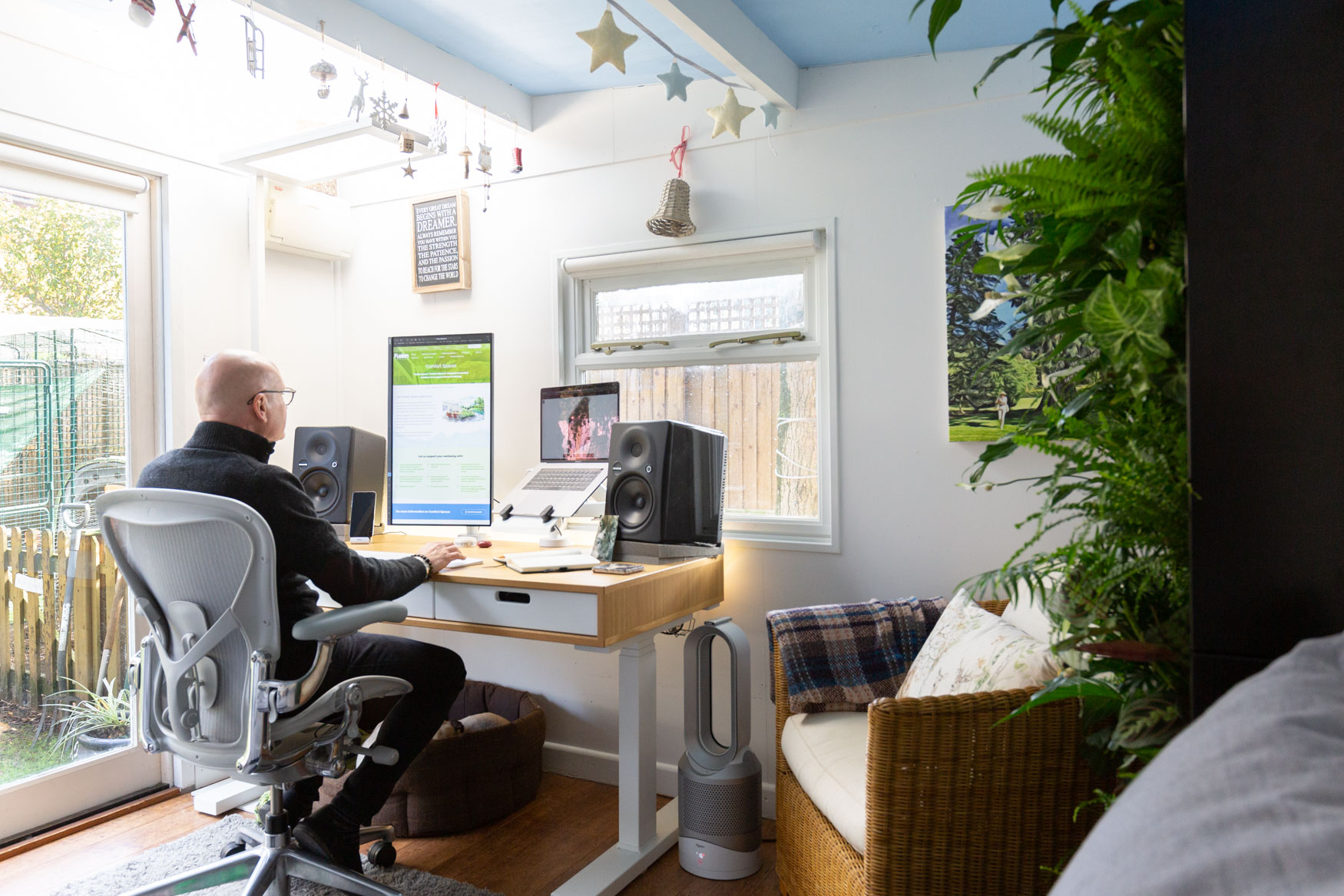
    Image of a home-working set up that is ergonomic and has elements of biophilic design
    Image by Simply-C-Photography for Fusion Spaces

    Biophilic design need not be confined to office buildings and other commercial spaces. The benefits of biophilic design can be obtained in the home office too, and without having to spend a fortune. This post explores the benefits of biophilic design and gives some very simple and cost-effective tips to help you thrive in your home working setting.

    What is biophilic design?

    Biophilic design is a design process that brings the theory of biophilia into the built environment. Biophilia is a theory rooted in evolutionary biology and genetics, and was first popularized by Edward O Wilson in his classic book, Biophilia, published in 1984. Essentially, the theory reminds us that we are animals that have spent over 99% of our evolutionary history living in environments, such as the open plains of Africa. During that time, our survival as a species depended our senses being fine-tuned to that environment, and our reliance on various species of plant, animal and fungus for food, shelter and fuel.

    image of the book cover of EO Wilson's booked entitles Biophilia

    It is only a few short centuries since we ceased being hunter-gatherers and domesticated ourselves to live in artificial environments, such as cities. In less than a thousand generations, we divorced ourselves from our natural environment and the sensory stimuli that we need to thrive.

    Biophilic design is a way of creating environments that rebuild some of those sensory and biological connections, which reduce stress and increase wellbeing and happiness. Consider the domestic chicken. As a wild animal, the jungle fowl is a forest-dwelling bird that thrives by scrabbling around on the ground, picking up a varied diet of seeds, leaves, insects and other invertebrates. When domesticated and placed in conditions of intense population density and cramped conditions, they fail to thrive. However, the free-range hen, even though far from its jungle home, has an environment much closer to its natural conditions, and can lead a less stressful life, often living longer and requiring fewer veterinary interventions.

    Image of battery hens
    Photo by Artem Beliaikin on Pexels.com

    The battery human, also once released into a free-range environment (even though we are still constrained by our physical environment and societal expectations – hunting and gathering in the streets of our cities will be frowned upon) will thrive, and biophilic design is one way of creating such an environment.

    The home office environment

    The office worker has, in many instances, been let loose from the constraints of the office. During the pandemic, the cathedrals of capitalism were deserted and the shiny factories of data processing and document production went quiet. Even now, offices are significantly less occupied than they were before Covid-19 and, despite the frantic calls from the owners and managers of underused and expensive property assets, it looks likely that working from home, at least part time, will remain a normal part of working life.

    Image of an unoccupied modern open-plan office

    As a result, the newly liberated office worker was forced to create a new working environment in their homes.

    For some, this has been easy – there may be a spare room that can be used, or space at a large dining table, or even a garden building that can be used. However, for many, especially younger people living in expensive shared accommodation, creating a usable space has proved a challenge.

    Good weather in the spring and summer gives opportunities to take breaks outdoors, whether in a garden, a public spark, or even a walk around the local streets. However, wet and cold autumn and winter weather means that the outdoors is a little less appealing. We need to consider how to create a working environment that maintains some of those connections with the outside world. So how do we do it?

    Image of a park in summertime

    Some simple tips for a biophilic home office

    Give yourself a view

    If possible, arrange your workspace so that when you look up from the keyboard or screen you can see out of a window. Even if the view is of another building, it will be something distant to focus on, and that will ease eye strain and bring give you a sense of what is going on outside – it might hello you decide whether to venture out on a break, or hunker down in the warm, but whatever the weather, you will connect to the world outside.

    Open a window

    An open window will refresh the air and flush out excess carbon dioxide and other pollutants generated from within the home. It will also bring the sounds of the outside world in – you may hear voices or birdsong or the sound of the wind. It might also be traffic noise, but even that can sometimes be a relief from silence.

    Buy some houseplants

    Image of a group of houseplants on a ledge

    This is the eye-catching, Instagram-friendly intervention that will illustrate the pages of the colour supplements and lifestyle websites. However, it is an effective way of bringing some life indoors.
    Houseplants need not be expensive or huge. Ikea, for example, has some terrific plants and pots at very good prices (and I am an expert on indoor plants, so you can trust my judgement on this). They add green interest to the indoor environment and also demand some care. Watering (not too much), cleaning and trimming and arranging plants can be very therapeutic.

    Follow your nose

    Our sense of smell is our most primitive – detecting chemicals in the environment (which is what the sense of smell is all about) was the first sense to evolve in the animal kingdom. We often react to scents instinctively and before we are consciously aware of them, so we can use fragrances to create a multi-dimensional sensory environment very easily. The range and quality of home fragrances is more comprehensive than ever before, so there is bound to be something appealing.
    I’m not going to go down the road of recommending particular scents for particular settings or tasks – we risk straying into pseudoscience – just choose something that you, and your housemates, like.

    Water

    We use our sense of hearing and smell to detect the presence of water, often before we see it – this is a survival mechanism. As wild animals, we needed to be able to find safe water – not just to drink, but to find prey that also needed a drink.

    The sound of rainfall or babbling streams can be found easily just by asking Alexa (or other smart speaker system). A fish tank or small indoor water feature can also be soothing.

    Take care of your skin

    The skin is your largest sense organ, but often the least stimulated in the working environment. As well as stopping your insides from falling out, your skin is home to sensors that detect temperature, pressure, movement and resistance, shape and texture and even changes in humidity and static electricity.

    Don’t starve it of sensation. Use different textures around your workstation and allow your skin to be stimulated. Create a breeze (not a draught), experience some sunlight, walk barefoot, wear less if the temperature (or your need to be on a webcam) allows it or even take a shower for pleasure rather than utility.

    Image of skin on a hand

    Comfort is the key

    Biophilic design isn’t just about plants. It isn’t about bringing nature indoors. It is about being comfortable – physically and mentally. Comfort brings happiness and happiness is the key to both life satisfaction and also job satisfaction. A little investment in comfort can pay huge dividends for the individual and employers relying on home-based workers.

  • What’s the difference between a space full of pretty plants and biophilic design?

    What’s the difference between a space full of pretty plants and biophilic design?

    Without a purpose behind a design, and the intent to make an environment better for the people that use it, we cannot describe a space as biophilic.

    Over the next few paragraphs (which are based on my presentation to Cultivate ’20 Virtual in July 2020), I am going to discuss what I think it means to build a biophilic design brand for interior landscapers and designers.

    It doesn’t mean what logo to use, or what name to give your business. It is more about the philosophy behind your business – your vision and your values.

    Why am I banging on about biophilic design – isn’t it what everyone is doing right now anyway?

    Biophilic design is the design trend of the moment. It is associated with greater wellbeing. However, many of its proponents think mainly, or only, in terms of the emotional, almost spiritual, need to connect with nature.

    This can be an effective approach, is easily understood and has a lot of merit.

    Let’s did a little deeper

    Research has consistently shown, for almost 50 years (maybe longer) that when we put plants in buildings, things get better.

    • People feel happier
    • Symptoms associated with sick building syndrome disappear
    • Stress can be reduced
    • People become more productive

    Various mechanisms for the benefits have been suggested – physical and psychological – but for years, all we had was a catalogue of discrete research projects without a compelling narrative to tie them all together.

    This is Ken Brewer. He was with Ambius (my former employer), and its predecessor companies for over 30 years and was the North America Technical Director. As well as being a much missed colleague and friend, he is the man who first told me about biophilia – some time in the early 2000’s.

    When he told me about it, the research that I (and many others) were doing suddenly made a lot more sense.

    The concept of Biophilia is not new

    However, it has been the work of Edward Wilson since 1984 (incidentally, the same year that the WHO first recognized Sick Building Syndrome), and more latterly Stephen Kellert, that has brought the concept of biophilic design to a much wider audience.

    Biophilia theory is rooted in evolutionary biology and genetics. It contends that we, as a species, have an inherent need to be in an environment that relates to our basic needs as a species.

    We evolved, and spent over 99% of our species’ history, in an environment resembling the savannah, and that is the environment that we instinctively feel most comfortable in: open, undulating landscapes with scattered and clustered vegetation and good access to water and shelter.

    Our senses evolved to work at their best in such an environment, and so it makes sense to create our artificial environments to stimulate our senses is much the same way as in our wild setting. This is where biophilic design differs from conventional interior design – it combines multiple design elements in a holistic way to stimulate our senses.

    The difference between a space full of pretty plants and biophilic design

    The offices of Segment in California (image by Ambius North America) incorporating many elements that might be considered biophilic

    At its core, biophilic design is a design philosophy that is based on biophilia, which incorporates natural elements and natural analogues in such a way as to create an environment that is stimulating, engaging and provides sensory stimuli that work together to minimize stress and discomfort.

    It triggers an emotional connection with the space as a result of an appropriate sensory balance and sense of psychological and physical comfort.

    There is a huge benefit to putting plants into buildings – the very act of enriching a space can have some profound effects in terms of wellbeing and productivity.

    The difference, however, between doing interior landscaping and biophilic design isn’t what you put in a building, but how what you put in a building speaks to the people that use the building. In other words, it isn’t about the products.

    It is also about why.

    Why has your client asked you to put plants in their building? What is the intent?

    Biophilic design has many definitions. Terrapin, for example, propose a number of characteristics that make up biophilic design in three broad categories, as we can see here.

    • Nature in the space
    • Nature of the space
    • Natural analogues

    The first and last of these are areas are what interior designers and interior landscapers are really good at. With a bit of imagination, they can be pretty good at the other as well.

    When combined well, these elements create a sensory environment that is harmonious. The sensory inputs we experience are congruent. They complement each other and allow us to understand our environment.

    When our senses are stimulated discordantly, when we can’t make sense of what we are seeing, feeling, hearing and smelling, then we become stressed. If we hear a threat, but can’t see it, or if we smell the ocean but see the grey walls of an office, it takes mental effort to come to terms with those stimuli.

    The importance of good organizational culture

    Craig Knight’s research, and that of others, has shown that the biggest impact on performance and wellbeing isn’t plants, art, smells, and everything else that we do, but it is organizational culture.

    The more people are empowered to manage their work and their work space, the better things are. Such empowerment can, and should for our industry, extend to engaging as far as possible with the end users of buildings – e.g. office workers – and giving them some agency over the plants and other enrichments.

    Get empowerment right, everything else follows

    And this doesn’t just mean with the clients. If designers get it right within their own organizations, they too will reap the benefits.

    In fact, I think that designers need to live the values that are sold to clients in order to sell those ideas credibly, and for employees to sell and service those ideas with conviction

    That’s how you build a biophilic brand identity: human-centric companies providing human-centric services.

    It seems to me that it is likely that there is quite a strong interaction between design and organizational culture (although more evidence is needed to determine the strength of the effect), and that there are some synergies to be exploited.  

    This can be represented simply as a diagram.  This is merely an untested hypothesis at present, but based on current evidence, an interaction between the extent of biophilic design and end-user empowerment might reasonably be expected to look something like this.

    The more you enrich a space, and make it interesting and biophilic, the better.

    Likewise, the more the end user is considered, the better – moving from design being done to the user, through being done for them, ultimately to being done with them.

    And this is where the principle of intent comes in.

    If an organization is willing to invest large sums to enrich a space with wellbeing in mind, then it may be reasonable to assume that the culture behind such a decision looks beyond physical comfort and considers issues such as empowerment, engagement, corporate citizenship behaviours, identity, and monitoring.  

    And, unless organizations make efforts to address the mental space in their organizations as well as the physical space, then they, and their workers are unlikely to fully realise their potential.

    For me, the ultimate goal of biophilic design is combining the best in design – all the plants and other elements – with the intent to make life better for the users of the space.

    If the intent for creating wellbeing isn’t there, then all you are doing is making spaces pretty.

    That’s better than nothing, but it’s not what I think is truly biophilic – genuine, human-centred spaces created with the wellbeing of the user in mind, with our senses stimulated harmoniously and designed by someone who really gets it.

  • Where we work now

    Where we work now

    Here in the UK, it is the last day of National Plants at Work Week, organized by the interior landscaping trade association, Plants at Work. Usually, this is a celebration of the benefits of greenery in the office.

    This year, however, our workplaces are very different, and may continue to be for a while yet, and Plants at Work have been discussing the ways by which we can all use plants wherever we work – the home office, kitchen table, spare room or even in the garden.

    Where we work is not just a room, with a desk and computer. For many, the place where we really work often isn’t physical at all, but inside our heads. The office and the laptop are just tools to communicate the outputs of work. For many, work can’t be measured by keystrokes or attentiveness to a camera or attendance at virtual meetings. At best, that is just a measure of activity.

    Certainly, for some jobs, activity measures are the only practical proxy of work outputs, but those for whom the office is primarily the place to transfer ideas to a document or communicate them to a colleague, then the place where those ideas are formed is the real workplace. That means being in environments that forge creativity.

    That could be a warm bath, or a walk in the woods. It could be the laptop on the dining table, but it may also be somewhere else entirely. Inspiration can happen anywhere and at any time – not just between 9 and 5 in an office block.

    As good a place to be creative as anywhere. Photo by Tanner Vote on Pexels.com

    For many years, those that have worked from home as a matter of course were often viewed with suspicion by employers and colleagues alike. Were they really working, or were they slacking off? (Were those employers incapable of actually measuring outputs?)

    Some employers did insist on monitoring remote staff using technology, but now that even those managers are forced to working at home, maybe there is a little more understanding that people can be trusted to do good work without the need for a desk in the corporate office.

    Evolution

    It may be that as we contemplate the future of work, there will be a more rapid evolution of the home working environment. Already, employers, faced with a future when more and more people will be working away from the corporate office for extended periods, are examining their responsibilities for creating safe and healthy working environments.

    This certainly includes getting technology right, and ergonomics. Good chairs and lighting are going to be vital, along with legal obligations such as complying with display screen regulations.

    As well as the bare minimum, enlightened employers might be considering providing some of the things that make office life more bearable – perhaps some professionally prepared plant displays (e.g. this service from a London firm, Indoor Garden Design through their new venture https://www.intrayplants.com/ ).

    Photo by Min An on Pexels.com

    Some are even offering the delivery of home office buildings, although that raises many questions.

    I wonder about how insecure a company must feel that it needs to remind its employees who they work for with a branded pod placed, presumably rent-free, in the back garden with the desk facing away from the window – recreating the environment of the office battery cage. If company culture has to be reinforced by having a massive logo, rather than by decent management, then I would be very worried. And what might be the consequence of hanging a poster over the logo?

    The pod itself looks really well designed – good acoustics, modern lighting and all pre-cabled, but is this where you will be expected to be creative and imaginative? Maybe a few pot plants would help.

    The nature of work is changing, and it is changing in ways not even imagined at the beginning of the year. Many office workers have had nightmares of trying to juggle space, homes schooling and caring along with work, but many have also experienced the benefits of being able to manage their work with more freedom, and have found themselves more productive, more creative and more engaged.

    By being forced to loosen the leash on staff, employers should be seeing the benefits of empowerment and trust. The benefits to employers and employees of being liberated from the constraints of the workplace battery farm need to be preserved.

  • Skin: our largest sense organ, and our least stimulated in the workplace

    Skin: our largest sense organ, and our least stimulated in the workplace

    I am strongly of the belief that biophilia is far more than the emotional and psychological connection to nature that is most often suggested as the basis of biophilic design. For me, true biophilic design is about creating physical and psychological comfort. It involves creating a sensory environment where our senses are stimulated congruently.

    Physical comfort depends on our brain interpreting the inputs of sense receptors, which allows us to create an internal map of our environment. This helps us know how to behave: whether to fight, flee, feed, shelter, nurture, create, etc. Stress hormones can prime us to move quickly, whereas our pleasure centres can encourage us to stay put and indulge more.

    An environment that allows our senses to work in concert should be comfortable and, in a workplace setting, will enhance effectiveness (thence engagement, productivity, job satisfaction, etc.)

    Designers can be very good at addressing many of our sensory needs, but all too often, our largest sensory organ is ignored.

    image of the skin on a hand

    Our skin is densely packed with sensors that react to temperature, air movement, pressure and even static electricity and chemical irritation. Our skin sensors tell us when a surface is safe to grip or walk on. We have sensors that provide feedback about the things we pick up, bend, twist, press, push and pull. Other sensors tell us when we are being exposed to excess heat or cold.

    Human beings are unique in nature in that we are the only species that covers most of its skin, thus depriving us of a huge amount of sensory information. However, that particular behaviour is a relatively recent innovation. Modern humans have only worn clothes for about a third of their time on Earth, and there is very little evidence to suggest that our hominid ancestors ever saw the need. As with our other senses (although to a lesser degree), evolution hasn’t caught up with the changes we have made to our habitats through migration and building – we are still essentially adapted to living wild on the open plains of Africa.

    Depending on the nature of the sensory inputs through our skin, we can experience great pleasure or immense pain. Those experiences are enhanced the more that the skin is exposed.

    One of the reasons we find draughts so annoying is that our skin is detecting air movement over only small parts of exposed skin, but not the rest. As a result, we get conflicting sensory inputs. Our neck and face might feel chilly, turbulent air currents, but the rest of us is wrapped up snug and warm. We have to use mental effort to understand what is going on.

    In workplaces, we deprive ourselves of tactile and haptic experiences. Surfaces are smooth (for easy cleaning, as well as aesthetics) and we spend so much of our time still, apart from tapping at keyboards or picking up the phone.

    So, what is the answer?

    There are few opportunities to expose the skin to the environment in most workplaces. Society is probably not yet ready for naturist offices (although homeworking during the pandemic lockdowns offered many the chance to experiment), so any tactile and haptic stimulation needs to be directed at whatever skin is exposed (face and hands in the main), or be felt through clothing.

    But it is not enough just to stimulate the skin, there can be purpose behind it.

    Textures can be used very effectively to demarcate spaces and indicate safe, or preferred routes (think of textured pavements near pedestrian crossings). They can also be used to indicate status and authority – thick carpets and soft textiles are often associated with luxury and opulence, as are natural materials such as wood and stone. Whilst the general office accommodation in a building might be a sea of laminate desks and hard-wearing carpet tiles, the executive floors tend to be more cosseting. These areas have an abundance of more natural materials and they often feature more interesting and varied textures.

    The indoor climate can also be managed in a way that is more in keeping with our sensory needs. I’ve already mentioned a reason why draughts are irritating, but other aspects of thermal regulation are important too. Heat and humidity, as well as air flow, can have a significant impact our comfort.

    Humidity is especially important as far as comfort is concerned. Too humid and the air is clammy and our clothes get sticky and damp, which is not comfortable. Too dry, and our skin needs artificial moisturising to prevent itching and irritation.

    In a typical workplace, our environment is pretty much fixed, or variable within a very limited range. In open offices, personal control is very limited. Office workers can neither change the environment nor their behaviours beyond a narrow spectrum.

    When not in the office, we can make adjustments to our behaviour to adapt to a changing environment. Uncomfortable skin can be made more comfortable by moving from one place to another, by adding or removing clothes or by taking a refreshing shower. We can choose to walk on carpet or a hard floor, or sit on a soft cushion or wooden bench. We can often change some elements of the environment ourselves, by changing the temperature, for example. We have agency.

    I first wrote this in May 2020, during the fifth week of the first lockdown in the UK. Most office workers were working from home. Perhaps, for the first time in their working lives, people were able to manage their working environment in ways that are not possible in an office building. Whilst it might have been lonely to be away from colleagues, it is likely to have been a more physically comfortable place to be. I wonder how much people will miss their control over their sensory environment when they return to the office. Maybe this is one reason why remote and hybrid working remains popular).

    Processing…
    Success! You're on the list.
  • Thoughts about indoor air quality and monitoring

    My recent post about the benefits of indoor air quality (IAQ) monitoring spoke about how monitoring can be empowering and lead to improved productivity and business effectiveness. It was written before the full impact of the Coronavirus lockdown really hit. One of the most interesting things about monitoring and measuring IAQ is how our perception of what is important varies according what we are doing and how we are feeling at any time. Our urge to control our environment, even if that control may end up with exposure to something harmful, is very strong.

    Photo by Kaique Rocha on Pexels.com

    A recent article in the Guardian highlighted some interesting research about the link between high levels of pollution and high levels of Covid-19 mortality, in particular, pollutants such as fine particulates, sulphur dioxide, nitrogen dioxide and ozone. Exposure to these pollutants seems to weaken the immune response and also damage the fine lining of the upper respiratory tract – the main site of infection by the virus.

    There is an excellent podcast featuring Professor Anna Hansell (professor of environmental epidemiology and director of the centre for environmental health and sustainability at the University of Leicester) explaining all of this here.

    Another report, also in The Guardian, adds weight to the link between Covid-19 and fine particulates, but this time suggesting that the virus might be carried on those particulates – two health threats for the price of one!

    What does this have to do with indoor air quality and monitoring, especially at the workplace?

    In modern airtight buildings with complex air management systems, it is possible to keep levels of these externally-generated pollutants down to safe levels. There are any number of air purifiers, filters and indoor vegetation systems that will help to manage this. And there are good IAQ monitors to help building operators to keep an eye on conditions. What cannot be managed, though, is the exposure of office workers to these pollutants on their daily commute or in their own homes.

    Older buildings are more difficult to manage. They are often permeable (or just plain draughty), may have opening windows (which many office workers regard as being very important, and which are very effective at enabling people to reduce productivity-destroying carbon dioxide in a matter of minutes).

    Openable windows would, in many situations, be great for businesses. Empowerment and physical comfort – both of which can be managed by the simple act of opening a window – are known to be drivers of performance. However, when opening a window means bringing in a load of invisible and harmful pollutants, then other measures must be taken.

    An IAQ monitor (preferably with a real-time display) would, of course, be the an ideal tool to have. It would show when levels of harmful pollutants exceed safe limits and show when to close the windows. By making the monitor visible to staff, as well as building managers, the decision to act is in the hands of the workers – empowerment is restored.

    Covid-19 has brought home how vulnerable we are when our respiratory tract is damaged. Pollution is something that we must pay more attention to – it is a modifiable risk factor. Not just within and immediately surrounding our workplaces (including our home workplaces – and who measures IAQ there?), but in the wider environment too. On our commute to work, where we take exercise, where we educate our children or house our senior citizens.

    The old saw, “you cannot manage what you cannot measure”, is in many instances nothing more useful than the cliched utterances of a contestant on The Apprentice. However, where air quality is concerned, there is a lot to be gained by measurement.

  • Air quality monitors for empowerment and performance

    Air quality monitors for empowerment and performance

    One of the most pernicious aspects of modern working is the use of monitoring equipment by organizations to keep their staff on their toes. Often such monitoring is used to determine productivity metrics (without much understanding of what productivity really means).

    However, there are some occasions where monitoring can be quite empowering, and that is in the area surrounding the use of environmental monitors, especially those for air quality.

    The new RESET standard, for example, is one of those certifications that has the potential to empower and embolden building users (office workers, retail customers, hotel guests, etc.) to demand changes to the environment for comfort and safety (and also productivity).

    The RESET standard (which has some degree of alignment with other building certification systems, such as WELL) not only requires several important parameters of indoor air quality to be measured and recorded (useful for building managers assessing the performance of their HVAC systems), but also to have indoor air quality reported in real time and displayed in such a way as to be accessible and understood by building users.

    Awair Omni indoor air quality monitor. The green indicator light and the score show that the air here is very good

    Such monitors can be very empowering. If they are visible and showing that there is something not quite right about the air, then that provides the evidence required to make a complaint to the facilities help desk. As well as the office worker seeing the data, the facilities help desk should be able to see the same information. Not only that, but there will be a record of the data, so trends can be observed and potential problems identified and fixed quickly. Furthermore, employers can be held to account if monitor data are not acted upon.

    Sometimes, people are reluctant to complain, for fear of being regarded as moaners. However, a dispassionate air quality monitor certainly empowers and emboldens people to encourage their employers to manage the environment better, or even hand over control, where practical, to the users of the space concerned. Where organizations are struggling to retain and recruit, such a visual demonstration of provision of a decent quality working environment is very helpful.

    Taking appropriate action

    My recent forays into the complex world of indoor air quality (and I claim little expertise beyond a couple of online courses and some fascinating discussions with real experts) has demonstrated just how complex and multi-dimensional the subject is. Even though there are many indices for air quality, it is an understanding of the relative importance of each parameter in different situations that is fascinating – and this goes beyond purely objective physiological impacts. It strays well into aspects of human behaviour.

    It is actually very important to recognise how individuals are pretty good at determining what matters to them.

    Whilst maintaining a safe environment always has to be a top priority for building operators, the fickleness and resourcefulness of the apparently irrational humans that populate the building have to be taken into account.

    In buildings where it is still possible to open windows, there is a risk that pollutants from outside will be brought in, which might worry a facilities manager doing their best to keep particulates out. However, that simple act of opening a window because the office is stuffy is both empowering (individual control rather than imposed conditions), but also might be the most effective way of getting rid of pollutants building up inside the building (carbon dioxide and VOCs for example).

    People are actually quite good at assessing some risks. At one building where I carried out some interviews of office workers, most people readily appreciated that there were risks of pollution coming in when opening a window (the office was only a few hundred metres from a busy motorway), but they were prepared to do that because they wanted to freshen the air and reduce stuffiness (associated with carbon dioxide, temperature and humidity).

    An air quality monitor might be one way to resolve arguments between facilities managers and building users – the decision to open the window can be validated by an improvement in the particular indoor air quality parameters that mattered to the user at the time.

    Air quality monitoring for performance

    Some recent research, for example that carried out by Joseph Allen (https://ehp.niehs.nih.gov/doi/10.1289/ehp.1510037, for example) shows clearly that elevated levels of carbon dioxide have a significant impact on cognitive ability.

    It only takes a few minutes in a meeting room for carbon dioxide levels to increase above levels that are detrimental to cognitive ability. One of Allen’s studies showed that, on average, a 400-ppm increase in carbon dioxide was associated with a 21% decrease in a typical participant’s cognitive scores.

    My own (rather informal) studies carried out in a small (but not untypical) meeting room showed that a small group of people in a 36 cubic metre room could increase carbon dioxide concentrations from a base level of approximately 500 ppm to over 1,200 ppm in under fifteen minutes.

    Given that important business decisions are often made in small meeting rooms, rather than well-ventilated open-plan offices, it is potentially very concerning that those critical decisions are made by people whose cognitive abilities are compromised by high levels of carbon dioxide – senior executives are just as susceptible to the effects of elevated carbon dioxide as anyone else.

    Photo by Christina Morillo on Pexels.com

    A good quality indoor air quality monitor might be one of the best investments a business can make.