Last week, we passed the autumn equinox. The day when we enter a period of more night time than daylight. More people are also working away from home as employers are trying hard to encourage their staff back to the office. With this in mind, please spare a thought for your houseplants.
Lights on in the home
Offices are getting busier and more people are spending their working hours away from home. We are also entering autumn. This means a lot less daylight, as a result of shorter days, less intense sunlight and far fewer hours of daylight.
It also means that the lights at home are off. On a dull day in an unlit house, light levels may be very low only a short distance from the windows. For houseplants, this can be tricky – they need light to photosynthesize, so prolonged darkness can cause problems. However, there are ways to minimize those potential issues.
By the windows
Cacti on a windowsill
If you haven’t already filled every available gap on your window sills with plants, now is the time to move some of your smaller plants a bit closer. Those that are sensitive to direct light (even at this time of year) such as Calatheas and Alocasias can go on north-facing window sills.
If you have a conservatory, and some room, some of your other plants might welcome a change of scene. Again, be aware that some species might not appreciate direct light, and watch out for cooler nighttime temperatures.
Many species, especially those with their natural origins in the undergrowth of a tropical rainforest, will be able to cope with the lower light levels quite easily without needing to be moved and without the need for additional lighting.
Plant by a window
Be smart with your lighting
A lot of people have embraced smart technology and can control much of their home through an app or smart speaker (such as an Amazon Alexa or Google Home device). Smart lighting is one way of giving your houseplants a light boost, and as many lights use very little energy, they won’t add too much to your energy bills (and may save the cost of replacing some plants). A few extra hours of lighting whilst you are away from the home can easily be programmed, and you can also programme your lights to be on when you get home. Having your lights turn on and off throughout the day can also be a useful security benefit.
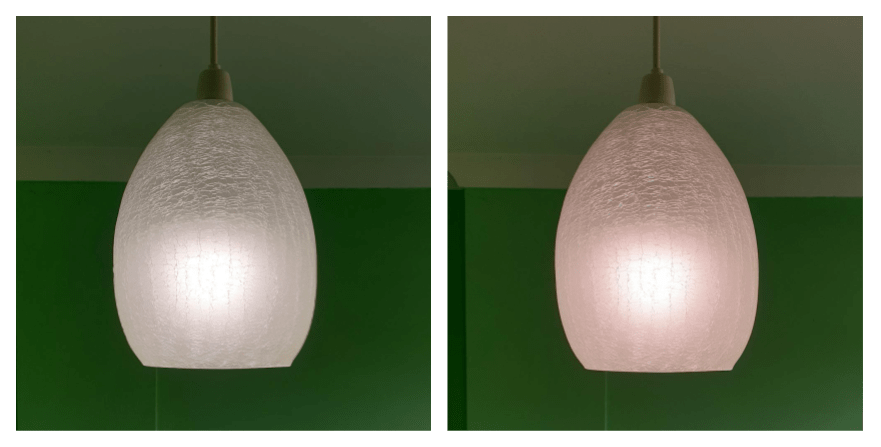
If your smart bulbs have different light quality settings, use daylight (sometimes called cool white) at the highest brightness during the day, and then change to a more comfortable warm white when you get home. You probably won’t need the lights to be on all of the time, but some species that do best in higher light conditions might benefit.
Comparison between daylight (l) and warm white (r) light from a programmable smart bulb
Cut back on water and feed
If you are spending more time away from the home, the chances are that as well as light being diminished, your home might be a little cooler as well: there is no need for the central heating if no-one is home.
If that is the case, your plants will be metabolizing a little slower, so they won’t be needing as much fertilizer and water as usual.
Always be guided by your plant – water according to the plant’s needs, not to a timetable. You can probably do without fertilizer until the spring as well.
If you have your houseplants potted in coir pots or set up with vulcaponics, that will certainly help regulate the water given to the plant. Adding water to the decorative pot and allowing it to soak gradually through the coir pot is an ideal way of managing the amount of water in the soil, reducing the risk of the roots becoming saturated.
Don’t worry
Most houseplants have their natural origins in the tropics and sub-tropics, where there isn’t much in the way of seasonal variation, much like inside a building. This is the main reason why native species of plants cannot cope with the indoor environment – they need seasonal variation to trigger different processes, such as flowering time or leaf drop.
However, when there is a seasonal change, some tropical houseplants will respond and you might notice more in the way of leaf drop than usual, especially on plants such as Ficus benjamina and other small-leaved tree species. Unlike temperate trees that tend to drop their leaves in the autumn, tropical species drop leaves continuously as they grow old, but you might find that if light and temperature levels do fall, they might drop more leaves as a result.
If this happens, don’t be alarmed (unless they drop all of their leaves). They will start producing a lot more foliage in the spring.
Ficus ‘Green Kinky’
Houseplants are pretty resilient. Breeders and growers have selected species and varieties over time to ensure that they can cope with the indoor environment. Working from home has probably given many houseplants a bit of a boost, but they will adapt to emptier, darker homes quite quickly.
Evidence-based design (EBD) emphasizes designing spaces based on measurable evidence rather than intuition. Originating in healthcare, EBD applies principles that focus on understanding client goals and developing relevant metrics. Engaging end-users throughout the design process enhances outcomes. By utilizing continuous data analysis, EBD aims to create efficient and user-centric environments.
What is evidence-based design?
Evidence-based design (EBD) is the design of spaces based on evidence, not simple ‘rules of thumb’ (also referred to as heuristics). The discipline of EBD was first developed in the healthcare industry, and its principles are increasingly being applied across the built environment.
An important part of the design process has to be a real understanding of what the client is really trying to achieve and then develop some metrics and indicators to determine whether those objectives have been achieved.
What is important for the customer? What is the starting point? What is the end point? How do we know that we’ve got there?
For example, is the client concerned about health and wellbeing, colleague engagement or productivity? These can all be measured, to an extent.
Some measurements may be physical or observational, e.g. how space is used. Other measurements might be associated with HR indicators such as absenteeism or complaints about the indoor air quality.
Maybe, the client is mainly interested in achieving a building certification (such as WELL) or a high Glassdoor rating in order to attract and retain staff (or to gain a “great place to work” recognition). These may require a different set of metrics and, in some cases, might be achieved by ticking boxes and completing spreadsheets without needing to engage with the end-users of the space at all.
Having said that, such a workplace, whilst meeting the specified end point of getting a certification, may not be especially effective. It is now well known that empowered, involved and engaged workers tend to be happier, healthier, more satisfied and more productive than those for whom a change was imposed.
However, without defining terms at the beginning of a project, the designer cannot really justify claims for its subsequent success. Objectives and KPIs must be clearly defined. If not, the wrong metrics may be used. Without good evidence, knowing what tweaks might be needed is impossible. This is especially true once a new workplace design has been commissioned to keep it working effectively.
If EBD is applied without direct involvement from the end-users, the designer limits the amount and quality of evidence available.
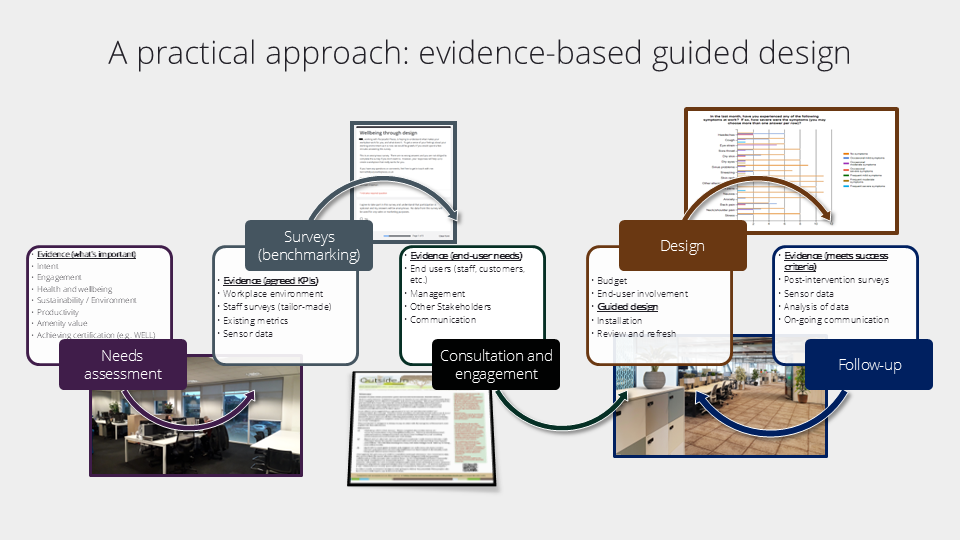
Five-step approach to evidence-based guided design
I will illustrate the process using an example of creating an new interior landscape scheme in an office-based workplace, although the principles would apply to almost any types of design project. Get in touch to discuss your specific needs.
Step 1: setting the intent and identifying needs
Here, we state the intent of the exercise. We seek to discover the needs of the client and identify any issues or areas that are important to the organization. These may relate to health and well being, productivity / financial indicators, staff engagement or even sustainability. Initial discussions would probably be with the client’s management team. It would be wise to also engage informally with the premises users at this time. This helps see if the management’s concerns align with those of their staff.
Outputs: KPIs agreed, scope and boundaries of surveys agreed, communications plan, workshops and end-user communications (e.g. newsletters)
Step 2: surveys and initial data
The next step would be to carry out a detailed set of surveys. This will include an assessment of the physical space (light, noise, layout, air quality, etc.) and a tailor-made staff survey, which will identify and quantify areas of concern. I can design these surveys for you so you get the information you really need.
The designer would also ensure that we have some objective baseline data from the client (if required) that could be compared against the designer’s own findings.
Outputs: initial surveys and data analysis, second staff communications, scope and boundaries of design agreed, design budget agreed.
Step 3: consultation and engagement
Before any intervention is made (for example, a redesign of the office space), the office staff should be kept engaged.
Research has demonstrated that giving office workers a genuine stake in the project (hearing their views and giving them real choices) results in better, and more durable, outcomes.
Throughout the process, the designer would ensure that all stakeholders in the project are kept informed of the progress of the project. This will be achieved using newsletters, social media and face-to-face discussions. At this point, the designer would have a fair idea of options available.
Outputs: ideas and requests collected from client’s staff, third staff communications
Step 4: design
At this point, an experienced design team would be brought in to discuss design options with all the stakeholders. The designer will have an idea of what might work after reviewing all the initial survey information. The designer will then present some outline options to the client.
The designer would then take their collected ideas forward for discussion and engage all users of the office space in the final decision. Once this has been agreed, the design team would make arrangements for the space to be redesigned accordingly.
Throughout this process, it is important to keep all stakeholders informed. There is often a few weeks lead time for a design to be installed. The designer and the client need to keep everyone’s enthusiasm alive. They should build up to the day when their ideas are realized in their newly-designed work space.
Outputs: first design proposals for discussion by staff and management. Revisions and final design choices. Design specification and order. Fourth (and possibly fifth) staff newsletter. Design installation.
Step 5: Follow-up and continuous review
The client will need to know whether the interventions carried out in the offices have been successful. Therefore, a series of follow-up surveys could be carried out shortly after the new designs have been installed. These surveys could include staff questionnaires, analysis of the client’s data, and physical measurements of the environment.
Such surveys might be repeated every 2 months or so for at least 9 months to confirm that the interventions have had a durable effect. If necessary, designs could be reviewed and adjusted as needed to satisfy the customer or end-users. Their experience may highlight unforeseen needs.
Again, the designer would continue to communicate and engage with all stakeholders to let them know what is going on, and to get some qualitative evidence as well as quantitative data.
Outputs: follow-up surveys, data analysis, continuing staff newsletters
How will you know whether an environment is successful?
At each step of the process, data will be gathered to determine whether process is working. Data for evidence-based design can come from direct, indirect or proxy sources.
Pre-intervention
At installation
Post intervention
Direct measures (examples)
End-user surveys End-user focus groups Sentiment / satisfaction measures Customer interviews Observational data Sensors and monitors
Discussions with end users – confirm needs have been met Discussions with customer – confirm needs have been met Sentiment / satisfaction measures
Ongoing Post intervention surveys (every few months for at least one year) Ongoing sentiment / satisfaction measures Interviews and focus groups Observational data Sensors and monitors
Indirect measures (examples)
WELL scorecard Fitwel scorecard RESET scorecard Sustainability scorecard Leesman index Revenue / person Revenue / square foot Absenteeism records Staff retention rates Review sites (e.g. Glassdoor, Trustpilot, etc.)
WELL scorecard Fitwel scorecard RESET scorecard Sustainability scorecard Leesman index Revenue / person Revenue / square foot Absenteeism records Staff retention rates Review sites (e.g. Glassdoor, Trustpilot, etc.)
Proxy measures (examples)
Tests and quizzes Simulations Comparison with similar organizations (impact seen with them probably similar to impact on us) Case studies References
Tests and quizzes Simulations Designer feedback
Tests and quizzes Simulations Comparison with similar organizations (impact seen with them probably similar to impact on us)
Big Brother is watching you
Direct sources of data may be from automated systems and sensors. Sensors are increasingly being used to give building managers and space planners real-time data on how space is used and the environmental conditions in different parts of a building. This is becoming increasingly important now that hybrid ways of working are becoming more common and workplace usage patterns are changing rapidly.
Data collected on environmental and space utilization parameters allows for rapid changes in layout or environmental management. This ensures that users get as comfortable and as useful a workspace as possible.
Mapping survey data to culture, demographics and location: unveiling the nuances
Understanding the collective preferences of the end users of the workplace – the office workers – is crucial. However, digging deeper into the data is essential. Attempting to map these preferences onto the cultural, demographic, and locational peculiarities of the organization can give invaluable insights. This reveals patterns and nuances that can be easily overlooked in broader surveys.
The benefits of longitudinal studies
Collecting survey data immediately before and after the installation of a new interior design is not especially valuable. People notice the immediate impact of change. However, tracking individual responses over time (whilst meticulously maintaining privacy) is very beneficial. It includes collecting data for an extended period post-intervention. This allows the designer to distinguish the subtle effects of design interventions from the larger waves of, say, a new CEO or a major business shift.
Granular analysis of data over time, ideally with the aid of a statistician, can offer a clear picture. It will reduce the risk of misinterpretations and helps to ensure that design decisions are informed by the most accurate trends.
Longitudinal studies, with frequent data analysis, also allow for post-design tweaks. Whilst easy-to-digest broad data can be appealing, the detail is where hidden gems of insight can be found.
Hidden gems
Demographic studies can hold surprising potential, as long as you know what to look for. For example, a seemingly innocuous study (carried out in the late 1990s) into the plant preferences of staff in a local government office revealed a hidden layer of cultural influence. The headline findings clearly showed a relationship between plant preference and the seniority of the office worker. Closer examination unearthed a deeper connection to gender, rooted in the organization’s history and norms. Men occupied the bulk of the senior positions, whilst there were far more women occupying more junior roles. This highlights the importance of not solely relying on surface-level observations and instead delving into the details woven into the data.
Another small study challenged preconceived notions by demonstrating that job role, regardless of age, could be a stronger reflector of plant preferences than previously thought. Stereotypes, both reinforced and shattered, illustrate the power of data to illuminate the complexities of human behaviour within a specific context.
Ultimately, mapping data to culture, demographics, and location is not about finding definitive answers, but rather about uncovering the rich tapestry of influences that shape how people interact with their environment. By exploring the nuances found in data, evidence-based design transcends mere aesthetics and can be a tool that transforms workplaces into spaces that truly resonate with their users.
Measuring the right thing!
If the aim of a project is to improve employee wellbeing, then there is no point in measuring the organization’s Net Promoter Score. Likewise, measuring indoor air quality is unlikely to tell you much about a company’s brand reputation.
Having said that, there are likely to be some interesting interactions. Improving indoor air quality may well have an impact on productivity, especially if carbon dioxide levels are kept low, leading to greater alertness and less fatigue. However, you won’t know if productivity has been improved unless you actually measure it. Similarly, whilst improving employee wellbeing may lead to a better NPS score – happy staff are probably going to give better customer service after all – NPS isn’t, on its own, going to be a reliable measure of wellbeing.
Here are some possible aims of a design interventions with some of the metrics that could be used.
Project aim
Possible metrics
Improved productivity
Revenue (or profit) per employee Revenue (or profit) per unit area of office space
Reduced absenteeism
Work days lost, long term absence, etc.
Increased office space utilization
Time spent in the office Workspace occupancy Sensor data
Improved wellbeing
Survey data: complaints of SBS, symptoms, reasons for absenteeism, etc. Health monitoring data
NPS data Ranking in reviews / indices (e.g. Glassdoor, Leesman, Trustpilot, etc.)
Improved colleague engagement
Staff engagement surveys, e.g. Q10, Hays Group,
Improved customer engagement
NPS Customer comments and complaints, reviews, etc. Customer satisfaction surveys Trip Advisor scores (for hospitality sector) Trustpilot scores (for service providers, retail, etc.) Increased footfall or dwell time (retail sector) Increase in return custom (retail, healthcare and hospitality) Customer referrals (retail, healthcare, hospitality)
Improved sustainability
GHG emissions normalized against revenue or per capita (rather than against floor space) Reductions in energy costs
Add value to your interior design
If you are involved in design, consider an evidence-based approach. This is especially important if you are an interior landscaper who wants to add value to your service. If you need help in putting together a programme, or if you need assistance designing surveys and other elements of data collection, then please get in touch. Check out my services page for information about my specific areas of expertise and consultancy.
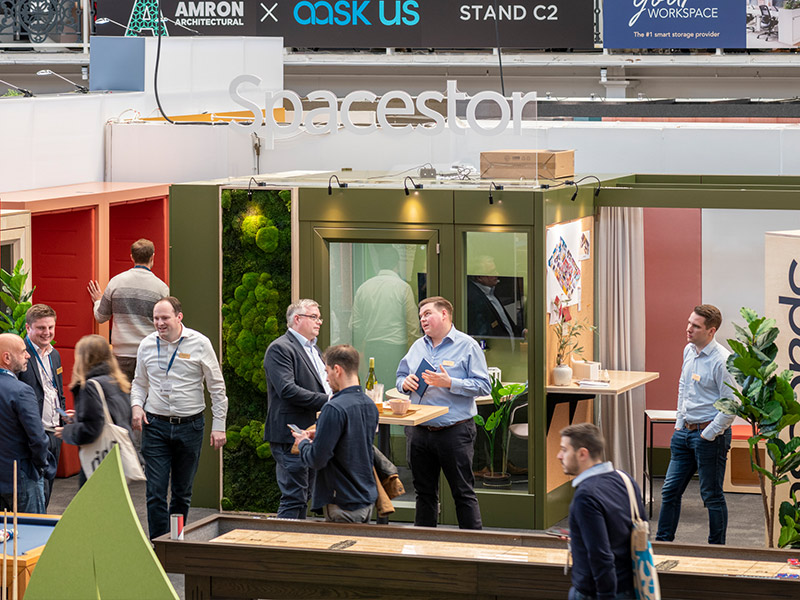
Last week, I visited the Workspace Design Show in London. It was a fascinating experience and there were lots of new, spangly products to help organizations create better, more effective workspaces, as well as some excellent talks and discussions.
It got me thinking about what it is that makes for a good office experience, and the characteristics of the best office environment that I have worked in.
I have been home-based for the last 14 years, but my various home offices over the years have not been the best offices that I’ve worked in.
One of my home offices (but not my current one)
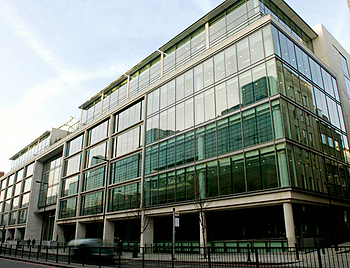
That office was in an ageing building belonging to the head office of a multinational FTSE 100 plc where I worked for a little over 10 years in the late 1990s and early 2000s.
So, what made it special?
It wasn’t the condition of the building, that is for sure. It was built in the late 1940s, with additions from later decades. The heating was ancient, the network was flaky, the windows were tatty (although they were openable) and every so often, a vein of asbestos would be found, necessitating disruptive and costly removal.
However, there were many things to like about it.
First, almost everyone, no matter how junior, had there own office, or shared with one other person. They were adequately furnished, but every office was different, and every one reflected the person that used it – we were able to personalise our workspace considerably – plants, pictures from home, etc. I was allowed to choose the colour on the wall when the office was redecorated (after the asbestos had been removed), and I even brought in a coffee machine and a radio!
Another reason for it being a good place to work was its layout. Everyone tended to leave their doors open, meaning anyone walking along the corridor could pop their heads in and have a chat – usually work related, but not always. The building was very long and narrow, with toilets at opposite ends, and the post room / copier room also at a far end. This meant that several times a day, dozens of colleagues would walk past the office or pass each other in the corridor. It was a very social space, and it was a creative and productive space as well.
There were other features that made it a good, productive and creative environment, not least the nature of the work that was carried out there. As well as offices, there were laboratories and workshops. It had a collegiate atmosphere with a lot in common with academic institutions, despite it being a very commercial operation. However, there were two features that really stood out.
First, due to the nature of much of the work that was going on, especially in the laboratories, breaks were at fixed times and everyone went to the canteen at the same time – a really good time to talk to colleagues in different departments, and a really good place to exchange ideas and solve problems. A lot of lateral thinking went on in those coffee breaks and many of those conversations turned out to be serendipitous.
Secondly, there was the fact that the buildings were set in landscaped grounds. The site was a country house set in several acres of gardens, so absolutely atypical of 99% of workplaces. But those grounds gave everyone that worked there access to space to decompress, relax and reset – or just enjoy the greenery.
Evolution
All that was achieved through a process of evolution and when I worked there, had developed over a period of roughly 50 years.
Of course, things change, and a new CEO decided that what the company really needed was a swanky open-plan floor in a posh, new office building in an expensive part Central London. The company crashed out of the FTSE 100 shortly afterwards, but I’m sure the two events weren’t entirely connected.
I recognise that my workplace was unusual, and had much more in common with an academic institution than the cut and thrust of a technology business or finance company. The building was owned by the company and its location was on the outskirts of a small town, not in a big city, but there are some lessons from that style of working that could be considered in modern metropolitan office buildings.
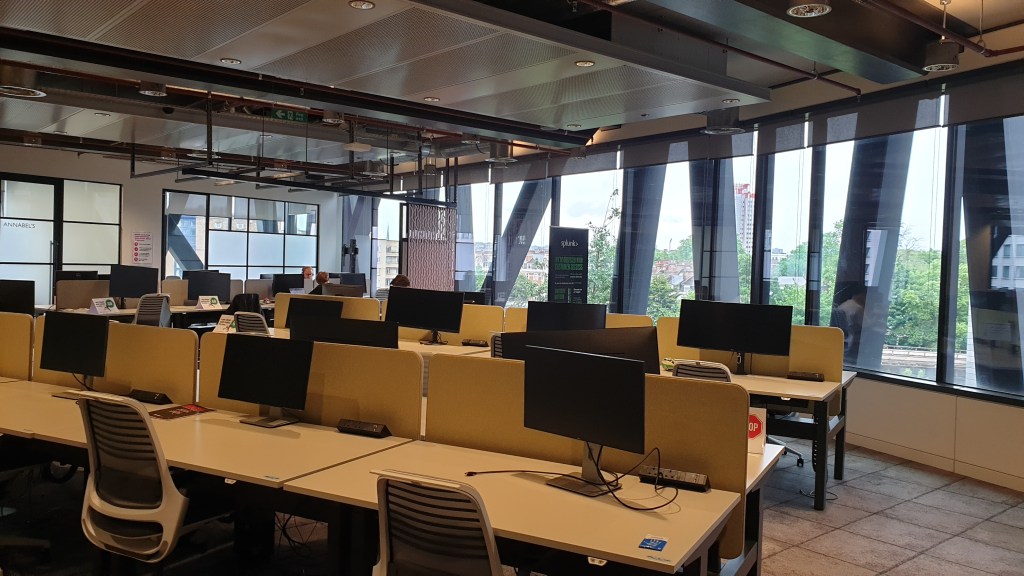
Having visited many office buildings in the last couple of years, most of which were barely a quarter-full, I have been struck by how organizations are desperately trying to create workplaces that will attract people to work in them – especially now that hybrid working patterns are taking hold and a lot of people would rather work from home.
The exhibitors at the show certainly had lots of ideas: zones for collaboration, pods for focused work and wellness rooms to recover from stress. Sofas and screens abounded, and of course, plants featured heavily (a good thing, of course). Every one of those solutions, however, lacked something really important – the ability for office workers to really realise something of their own identity. And as has been explained in older posts – identity realisation is the key to productivity. My friend Dr Craig Knight explains more here.
Whilst some degree of autonomy is available (the choice to work in a zone, pod or hot desk, for example), there is very limited ability to personalize individual workspaces. Despite huge budgets to create comfortable, ergonomic and efficient workspaces, and the provision of many amenities, such as high quality catering and recreation spaces, the new office building still remains far removed from the home environment where you can arrange your working environment to suit you.
Is it possible to recreate the style of office working that I experienced 25 years ago in a modern office building?
I don’t know. It would require people like HR managers and brand managers to relax a bit, and it might mean a different approach to space management, or even the architecture of office buildings.
Of course, my personal experience of what made for a good environment is just that – my own, personal experience. What worked for me might not work for anyone else at all, and the current design and management of workspaces might actually be the best possible way – feel free to comment.
Lots of people are selling products that are supposed to improve indoor air quality. They may be air purifiers, filter systems, complex green walls or even pot plants. Many claims are made, but how do you know whether the systems you are buying are doing what you need them to do? This is where air quality monitoring comes into its own.
(By the way – I’m not trying to sell you an indoor air quality monitor, or any form of air purifier. However, I can help your business set up an IAQ monitoring project and even help you on your way to gaining a RESET certification for your buildings, which will also help you with WELL and Fitwel certifications – please get in touch if you want to know more).
Why monitor indoor air quality?
Good indoor air quality is often thought of subjectively. Human perception of good air quality is difficult as our senses evolved to deal with environments that were unpolluted. As long as we could detect smoke, which suggested an immediate threat (or, conversely, the possibility of a cooked meal and convivial company), air quality was not much of a concern to our plains-dwelling ancestors.
Inside buildings, we often only notice an issue with air quality when it directly affects our comfort. We might describe the air as heavy, fusty, stale or stuffy. Stuffiness (often as a result of elevated carbon dioxide from our exhalation, combined with warm temperatures and high humidity) can be alleviated by opening a window. Carbon dioxide (and airborne viruses, such as Covid-19) inside the building is diluted by bringing outside air in, and humidity and temperature might also be made more comfortable. This improvement to our comfort, achieved by a perceived improvement to indoor air quality, is not the whole story.
Opening the windows might risk exposure to other harms that are not readily detected by human senses. Fine particulates, volatile organic compounds or various oxides of nitrogen or sulphur are not usually detectable by human senses, so how do we know whether they are present?
Only by using calibrated IAQ monitors that measure, record and report key parameters of air quality can you then set out to manage air quality and reassure the users of the building that their safety and comfort is being looked after.
Without data from air monitoring, any management of indoor air quality is pretty-much based on guesswork, which is inadequate for the proper management of risk in a building.
My new white paper explains how and why organizations should develop an indoor air quality monitoring and management programme, which you can download here.
Here in the UK, it is the last day of National Plants at Work Week, organized by the interior landscaping trade association, Plants at Work. Usually, this is a celebration of the benefits of greenery in the office.
This year, however, our workplaces are very different, and may continue to be for a while yet, and Plants at Work have been discussing the ways by which we can all use plants wherever we work – the home office, kitchen table, spare room or even in the garden.
Where we work is not just a room, with a desk and computer. For many, the place where we really work often isn’t physical at all, but inside our heads. The office and the laptop are just tools to communicate the outputs of work. For many, work can’t be measured by keystrokes or attentiveness to a camera or attendance at virtual meetings. At best, that is just a measure of activity.
Certainly, for some jobs, activity measures are the only practical proxy of work outputs, but those for whom the office is primarily the place to transfer ideas to a document or communicate them to a colleague, then the place where those ideas are formed is the real workplace. That means being in environments that forge creativity.
That could be a warm bath, or a walk in the woods. It could be the laptop on the dining table, but it may also be somewhere else entirely. Inspiration can happen anywhere and at any time – not just between 9 and 5 in an office block.
As good a place to be creative as anywhere. Photo by Tanner Vote on Pexels.com
For many years, those that have worked from home as a matter of course were often viewed with suspicion by employers and colleagues alike. Were they really working, or were they slacking off? (Were those employers incapable of actually measuring outputs?)
Some employers did insist on monitoring remote staff using technology, but now that even those managers are forced to working at home, maybe there is a little more understanding that people can be trusted to do good work without the need for a desk in the corporate office.
Evolution
It may be that as we contemplate the future of work, there will be a more rapid evolution of the home working environment. Already, employers, faced with a future when more and more people will be working away from the corporate office for extended periods, are examining their responsibilities for creating safe and healthy working environments.
This certainly includes getting technology right, and ergonomics. Good chairs and lighting are going to be vital, along with legal obligations such as complying with display screen regulations.
As well as the bare minimum, enlightened employers might be considering providing some of the things that make office life more bearable – perhaps some professionally prepared plant displays (e.g. this service from a London firm, Indoor Garden Design through their new venture https://www.intrayplants.com/ ).
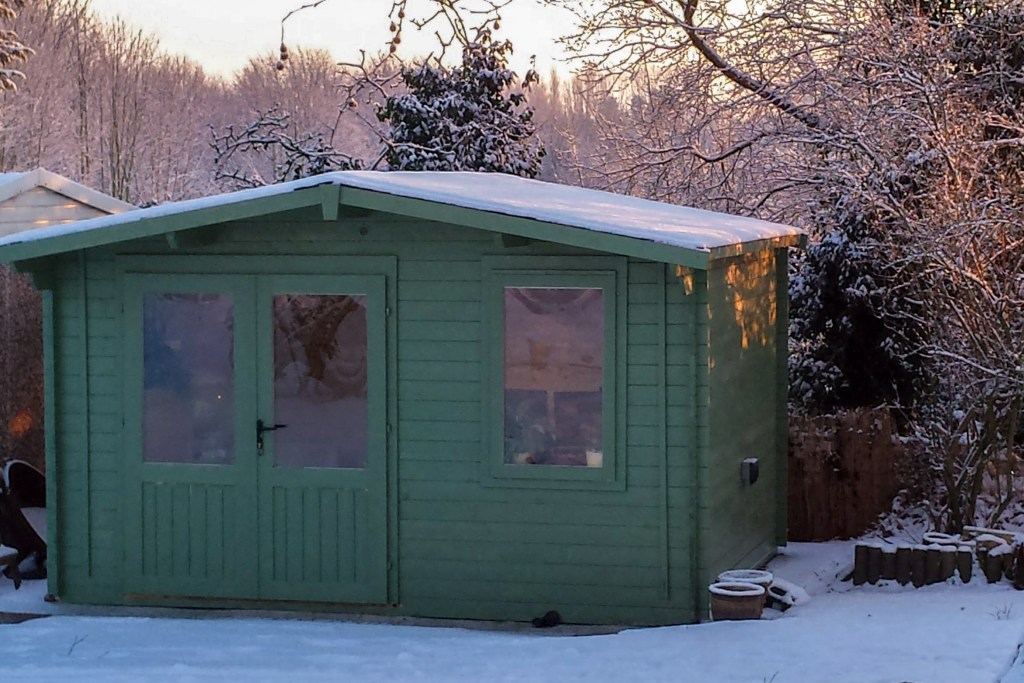
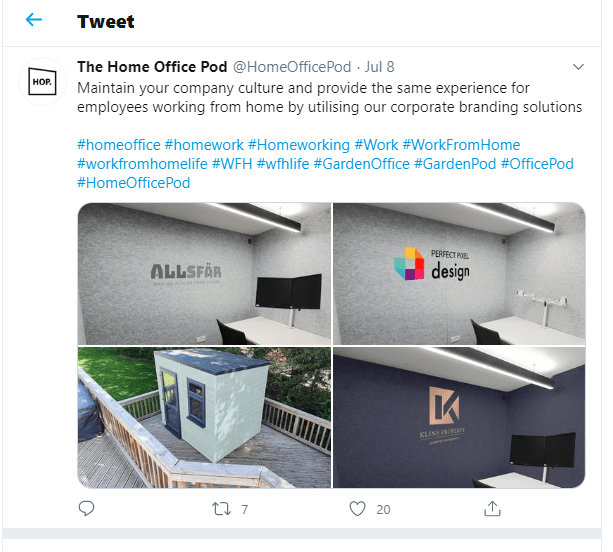
Some are even offering the delivery of home office buildings, although that raises many questions.
I wonder about how insecure a company must feel that it needs to remind its employees who they work for with a branded pod placed, presumably rent-free, in the back garden with the desk facing away from the window – recreating the environment of the office battery cage. If company culture has to be reinforced by having a massive logo, rather than by decent management, then I would be very worried. And what might be the consequence of hanging a poster over the logo?
The pod itself looks really well designed – good acoustics, modern lighting and all pre-cabled, but is this where you will be expected to be creative and imaginative? Maybe a few pot plants would help.
The nature of work is changing, and it is changing in ways not even imagined at the beginning of the year. Many office workers have had nightmares of trying to juggle space, homes schooling and caring along with work, but many have also experienced the benefits of being able to manage their work with more freedom, and have found themselves more productive, more creative and more engaged.
By being forced to loosen the leash on staff, employers should be seeing the benefits of empowerment and trust. The benefits to employers and employees of being liberated from the constraints of the workplace battery farm need to be preserved.
One of the most pernicious aspects of modern working is the use of monitoring equipment by organizations to keep their staff on their toes. Often such monitoring is used to determine productivity metrics (without much understanding of what productivity really means).
However, there are some occasions where monitoring can be quite empowering, and that is in the area surrounding the use of environmental monitors, especially those for air quality.
The new RESET standard, for example, is one of those certifications that has the potential to empower and embolden building users (office workers, retail customers, hotel guests, etc.) to demand changes to the environment for comfort and safety (and also productivity).
The RESET standard (which has some degree of alignment with other building certification systems, such as WELL) not only requires several important parameters of indoor air quality to be measured and recorded (useful for building managers assessing the performance of their HVAC systems), but also to have indoor air quality reported in real time and displayed in such a way as to be accessible and understood by building users.
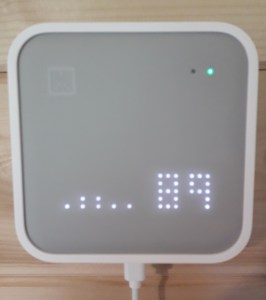
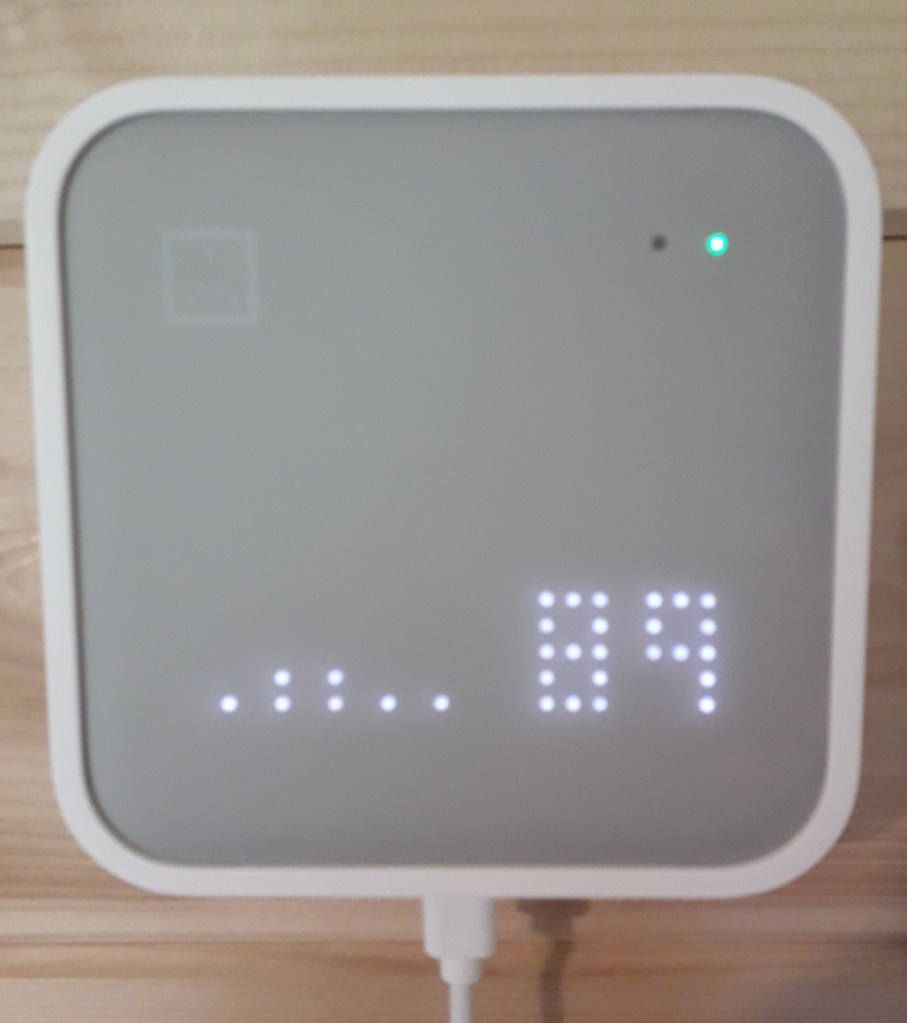
Awair Omni indoor air quality monitor. The green indicator light and the score show that the air here is very good
Such monitors can be very empowering. If they are visible and showing that there is something not quite right about the air, then that provides the evidence required to make a complaint to the facilities help desk. As well as the office worker seeing the data, the facilities help desk should be able to see the same information. Not only that, but there will be a record of the data, so trends can be observed and potential problems identified and fixed quickly. Furthermore, employers can be held to account if monitor data are not acted upon.
Sometimes, people are reluctant to complain, for fear of being regarded as moaners. However, a dispassionate air quality monitor certainly empowers and emboldens people to encourage their employers to manage the environment better, or even hand over control, where practical, to the users of the space concerned. Where organizations are struggling to retain and recruit, such a visual demonstration of provision of a decent quality working environment is very helpful.
Taking appropriate action
My recent forays into the complex world of indoor air quality (and I claim little expertise beyond a couple of online courses and some fascinating discussions with real experts) has demonstrated just how complex and multi-dimensional the subject is. Even though there are many indices for air quality, it is an understanding of the relative importance of each parameter in different situations that is fascinating – and this goes beyond purely objective physiological impacts. It strays well into aspects of human behaviour.
It is actually very important to recognise how individuals are pretty good at determining what matters to them.
Whilst maintaining a safe environment always has to be a top priority for building operators, the fickleness and resourcefulness of the apparently irrational humans that populate the building have to be taken into account.
In buildings where it is still possible to open windows, there is a risk that pollutants from outside will be brought in, which might worry a facilities manager doing their best to keep particulates out. However, that simple act of opening a window because the office is stuffy is both empowering (individual control rather than imposed conditions), but also might be the most effective way of getting rid of pollutants building up inside the building (carbon dioxide and VOCs for example).
People are actually quite good at assessing some risks. At one building where I carried out some interviews of office workers, most people readily appreciated that there were risks of pollution coming in when opening a window (the office was only a few hundred metres from a busy motorway), but they were prepared to do that because they wanted to freshen the air and reduce stuffiness (associated with carbon dioxide, temperature and humidity).
An air quality monitor might be one way to resolve arguments between facilities managers and building users – the decision to open the window can be validated by an improvement in the particular indoor air quality parameters that mattered to the user at the time.
Air quality monitoring for performance
Some recent research, for example that carried out by Joseph Allen (https://ehp.niehs.nih.gov/doi/10.1289/ehp.1510037, for example) shows clearly that elevated levels of carbon dioxide have a significant impact on cognitive ability.
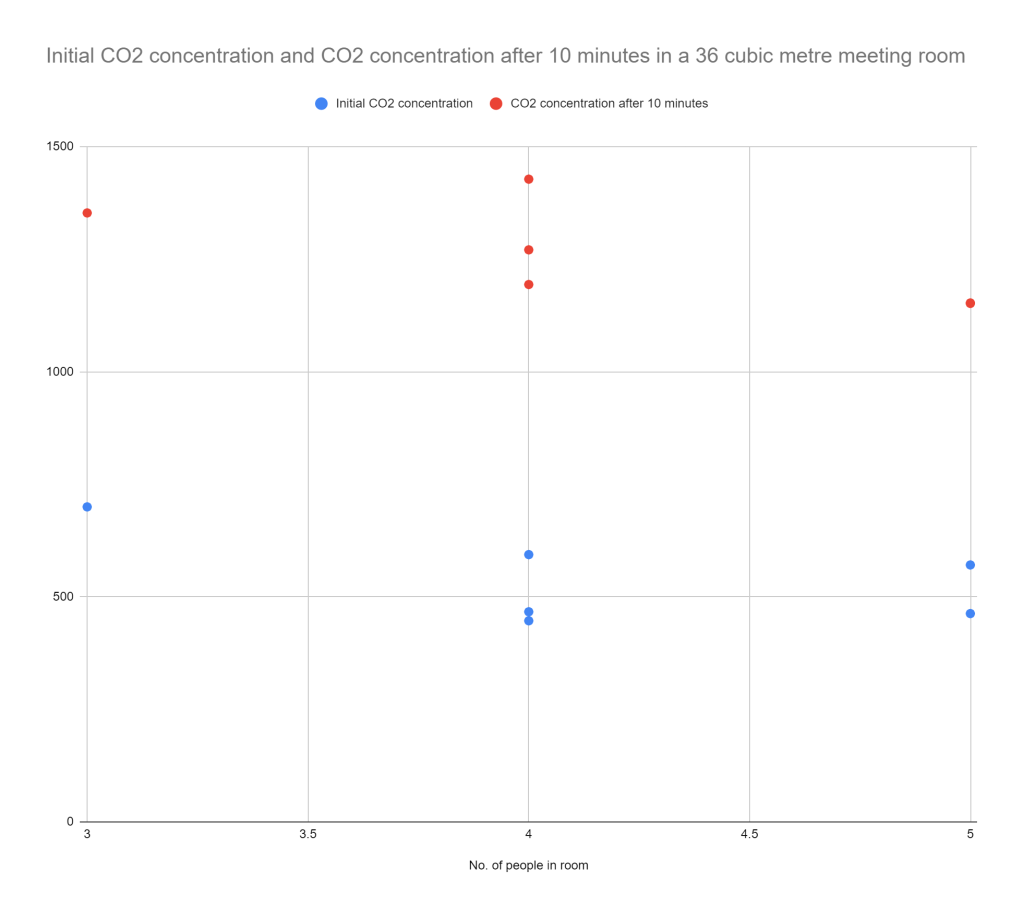
It only takes a few minutes in a meeting room for carbon dioxide levels to increase above levels that are detrimental to cognitive ability. One of Allen’s studies showed that, on average, a 400-ppm increase in carbon dioxide was associated with a 21% decrease in a typical participant’s cognitive scores.
My own (rather informal) studies carried out in a small (but not untypical) meeting room showed that a small group of people in a 36 cubic metre room could increase carbon dioxide concentrations from a base level of approximately 500 ppm to over 1,200 ppm in under fifteen minutes.
Given that important business decisions are often made in small meeting rooms, rather than well-ventilated open-plan offices, it is potentially very concerning that those critical decisions are made by people whose cognitive abilities are compromised by high levels of carbon dioxide – senior executives are just as susceptible to the effects of elevated carbon dioxide as anyone else.














 Kenneth Freeman | Purposeful Places