Category: environment

  • Get the light right

    Get the light right

    The evolution of interior landscaping has been affected by modern LED lighting, which lacks essential Far-Red and Near-Infrared wavelengths crucial for both plant health and human well-being. This absence disrupts phytochrome responses in plants, leading to inadequate adaptation strategies and reduced growth efficiency, ultimately compromising their longevity in indoor environments.

    When I started in the world of interior landscaping, many years ago, the plants were usually the last thing to go into a building. Unless there were some big planter beds and atriums where trees and large-scale planting would be planned, most plant displays were in standalone planters.

    This meant that interior landscape sales and design specialists were often brought into a project very close to the end of the design process. Furniture was in place and the lighting was installed.

    A designer would visit the location, measure the light precisely where the plants were to be positioned and (usually) order the right plants for the prevailing lighting conditions.

    Things have changed. Plants seem to be struggling where once they thrived, and it may not be as a result of poor plant quality from the growers, or poor maintenance by the interior landscapers.

    Indoor lighting has changed

    On 17 November 2025, I was fortunate enough to attend the second International Biophilic Design Conference in London. It was a packed day with several standout presentations. One that struck me as important was given by Ulysse Dormoy on the subject of light.

    Ulysse Dormoy’s presentation spoke mainly about the role of far red (FR) and near infrared (NIR) wavelengths and their impact on human health. These wavelengths are just beyond the visible spectrum, and are essential for human health. This energy penetrates soft tissue and drives the reactions that take take place in mitochondria – organelles in every living cell (plants as well as animals) that power life.

    The modern built environment – especially office buildings – relies on highly efficient LED lighting to illuminate our spaces. Modern, energy-efficient LEDs used in offices are often optimized to peak in the blue spectrum and only a narrow band of red (which is difficult to achieve in LEDs without losing efficiency) – this is fine for vision.

    However, LED lights are almost devoid of the NIR and Far-red components prevalent in both sunlight and older light sources, such as incandescent and fluorescent lamps. Couple this with the treatments applied to glazing to minimize excess heat getting into buildings from sunlight, then we have a problem that might affect human health.

    For humans, the absence of NIR means the loss of a key input for mitochondrial health, called photobiomodulation (PBM). This may lead to impaired cellular energy management that is thought to be linked to accelerated aging and reduced healthy lifespan.

    So what?

    What has this to do with biophilic design and, from my specialist point of view, interior plants?

    As far as light is concerned, interior landscapers are faced with two problems. The first is light measurement and knowing whether there is enough for plant health.

    Conventionally, interior landscapers measure light using instruments that measure light intensity – measured in lux (or footcandles in North America). When interior lights were incandescent or fluorescent, then measuring light intensity was good enough. Indoor lights of this type produced wavelengths that were good for photosynthesis and there was a close enough correlation between light intensity and photosynthetically active radiation (PAR) to mean that measuring light intensity was acceptable. Indeed, for decades, interior landscapers have relied on data sheets for indoor plants giving a range of light levels in lux (or footcandles) to aid specification.

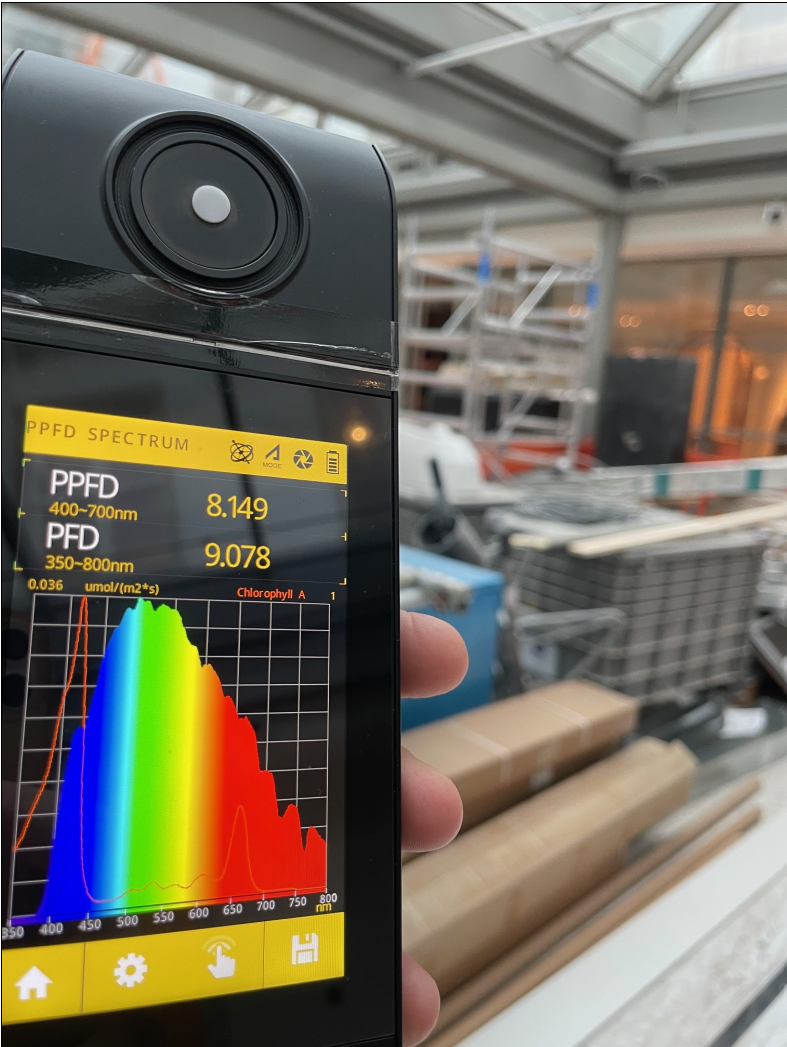
    PAR is a more accurate measure of useful light, and is measured as photosynthetic photon flux density – PPFD. With changes to lighting technology, PAR measurement might be the only way to understand what light is available to plants.

    a PAR meter showing the light spectrum inside a building

    PAR is measured using much more expensive instruments than light intensity meters (shown above).

    Unfortunately, no readily-available data exists for the PAR requirements of interior ornamental plants (although it does for salad crops, herbs and other plants grown in indoor farms). So even though the cost of PAR light meters is falling, without a reference point, interior landscapers don’t really know if the lighting in an office is going to be correct.

    Who knows how many micromoles of photosynthetically active photons per square metre of leaf surface, per second, are needed for the optimal growth of a peace lily? I don’t, and I’m supposed to be an expert!

    The second problem we face is akin to the human health angle.

    Phytochromes

    Just as humans need near infrared light for health, so do plants. Plants, like animals and fungi, have mitochondria. But they also rely on changes in the proportion of red and far red wavelengths to drive physiological processes that are not part of photosynthesis. These are the phytochrome reactions. The phytochrome system controls several growth and structural responses in plants, which govern the plant’s architecture and life cycle.

    The phytochrome system functions as a molecular switch that allows the plant to perceive its light environment, particularly whether it is exposed to direct sun or under the shade of a competing canopy. This perception controls critical developmental processes.

    Phytochromes are a family of chromoproteins that primarily absorb light in the 600–750 nm range. There are two interconvertible forms, distinguished by their maximum absorption peaks. The biologically inactive state, Pr (which stands for red-light absorbing form) is the default form synthesized in the dark. The biologically active state, Pfr, (which stands for Far-red light absorbing) is typically required to initiate developmental responses like germination or to inhibit stem elongation.

    Red light (approximately 660 nm) is the activating signal. Exposure to red light quickly converts the inactive Pr form to the active Pfr form. A high proportion of Pfr signals full sunlight, triggering responses such as:

    • the promotion of seed germination (in light-requiring seeds),
    • inhibition of stem elongation (to maintain a compact, high-light-adapted form), and
    • induction of flowering in some plant species.

    Far-Red Light is the deactivating signal. Exposure to far-red light quickly converts the active Pfr form back to the inactive Pr form

    The Red:Far-Red (R:FR) ratio and interior landscaping

    As the sun tracks across the sky, and as seasons change, the ratio of red and far red light in the spectrum also changes. For optimal non-photosynthetic, light-driven processes, the wavelengths are not just about intensity, but about the ratio between the two main absorption peaks.

    The Red:Far-Red (R:FR) ratio is the environmental parameter the phytochrome system is primarily able to sense, providing a crucial mechanism for shade avoidance. Direct Sunlight (High R:FR ratio of approximately 1.1–1.2) is natural, unfiltered light, which is rich in red light, leading to a high proportion of the active Pfr form. The plant perceives this as optimal growth conditions.

    Canopy Shade (Low R:FR ratio of approximately 0.2–0.7) is found when light passes through a plant canopy. Chlorophyll strongly absorbs the red wavelengths (used for photosynthesis) but transmits or reflects the far-red wavelengths (which are less useful for energy fixation, but good for mitochondrial health in animals, such as humans). This skews the light spectrum toward far-red, rapidly converting Pfr back to Pr.

    When the R:FR ratio drops (due to shade), the plant registers an urgent need to escape competition. This shift to the inactive Pr form triggers the shade avoidance syndrome, resulting in rapid stem elongation (etiolation), petiole extension, and suppression of branching. This isn’t an adaptation to low light, but an emergency response to get into brighter light.

    The built environment challenge

    As explained earlier, modern, high-efficiency LED lighting often lacks or is deficient in far-red and NIR wavelengths compared to older light sources. For indoor plants, a lack of the far-red signal (730 nm) can prevent the proper establishment of the shade-avoidance mechanism. If the R:FR ratio is skewed too high by narrow-spectrum red LEDs (a common energy-saving configuration), the plant may struggle because it loses the far-red component. This is critical for growth and development processes tied to phytochrome A, which is the primary photoreceptor for FR responses. Even though the plant is photosynthesizing, its morphological development is regulated by a spectral signal that does not fully mimic the complexity of the natural sun/shade environment. This leads to suboptimal plant architecture and poor acclimation.

    Office buildings are dark places compared with the outside world. Even on a cloudy, winter day, daylight is several orders of magnitude brighter than that which is found indoors in even the most brightly-lit office. Our eyes adapt quickly to low light levels, but plants can’t.

    The plant’s phytochrome system primarily detects the R:FR ratio to determine if it is under a competing canopy, not the overall photon density. In an indoor environment dominated by typical lighting (high in blue/green wavelengths, but little FR), if the light source is a standard LED or fluorescent lamp that has some red peaks but very little Far-Red, the R:FR ratio will be high (similar to direct sunlight). This results in a response suppression. The plant maintains a high level of the active Pfr form of phytochrome, signalling “full light.” This suppresses the shade avoidance syndrome (etiolation).

    However, there is another problem.

    Far-red light is not just a signalling mechanism.

    It is also an efficiency booster for photosynthesis itself. This is called the The Emerson Effect. Essentially for indoor plants, by completely removing FR from the indoor light spectrum, modern LEDs seem to be reducing the overall efficiency of photosynthesis. This makes the plants less efficient at utilizing the even the low light quantities they do receive. This further exacerbates their struggle. Therefore, while the lack of FR prevents undesirable etiolation, it forces the plant into a compromise that prevents true low-light adaptation and limits the efficiency of its remaining photosynthetic processes.

    The plant structurally maintains a compact, short-stemmed, sun-adapted form, but the actual photosynthetically active radiation (PAR) remains too low. The plant is tricked into behaving as if it is in high light when it is actually in low light. True, long-term low-light adaptation (shade adaptation) involves changes to the photosynthetic machinery, such as

    • Increased chlorophyll density (producing more chlorophyll per unit area to maximize the capture of scarce photons),
    • Thinner, larger Leaves that maximize the surface area for light interception and reducing the energy spent on thick, robust leaves.

    This shade adaptation is a slow process and starts on a grower’s nursery and has meant, in the past, that indoor plants can cope with office lighting conditions.

    However, a high R:FR ratio (due to lack of FR) actively inhibits these true shade-adaptation responses. The plant remains stunted but not acclimated. It is physiologically light-starved because its genetic programming, signalled by the high R:FR ratio, is telling it to stay structurally compact and save energy, making it struggle even more over time.

    When incandescent and some fluorescent lights were used, the low light levels – which the plants could adapt to – they had the right R:FR ratio. Now, they don’t and indoor plants, which are well acclimated to low overall light levels, are struggling and not living as long.
  • Cabinet-top planters: think of them as horizontal green walls

    Cabinet-top planters: think of them as horizontal green walls

    Office designers are increasingly using cabinet-top planters, but these shallow containers often result in poor plant health due to rapid water depletion and incompatible species. To improve outcomes, designers should consult professional interior landscapers and consider hydro-culture or low-water plants, while potentially adjusting service cycles to better maintain these installations.

    Shallow planter mounted on the top of office furniture

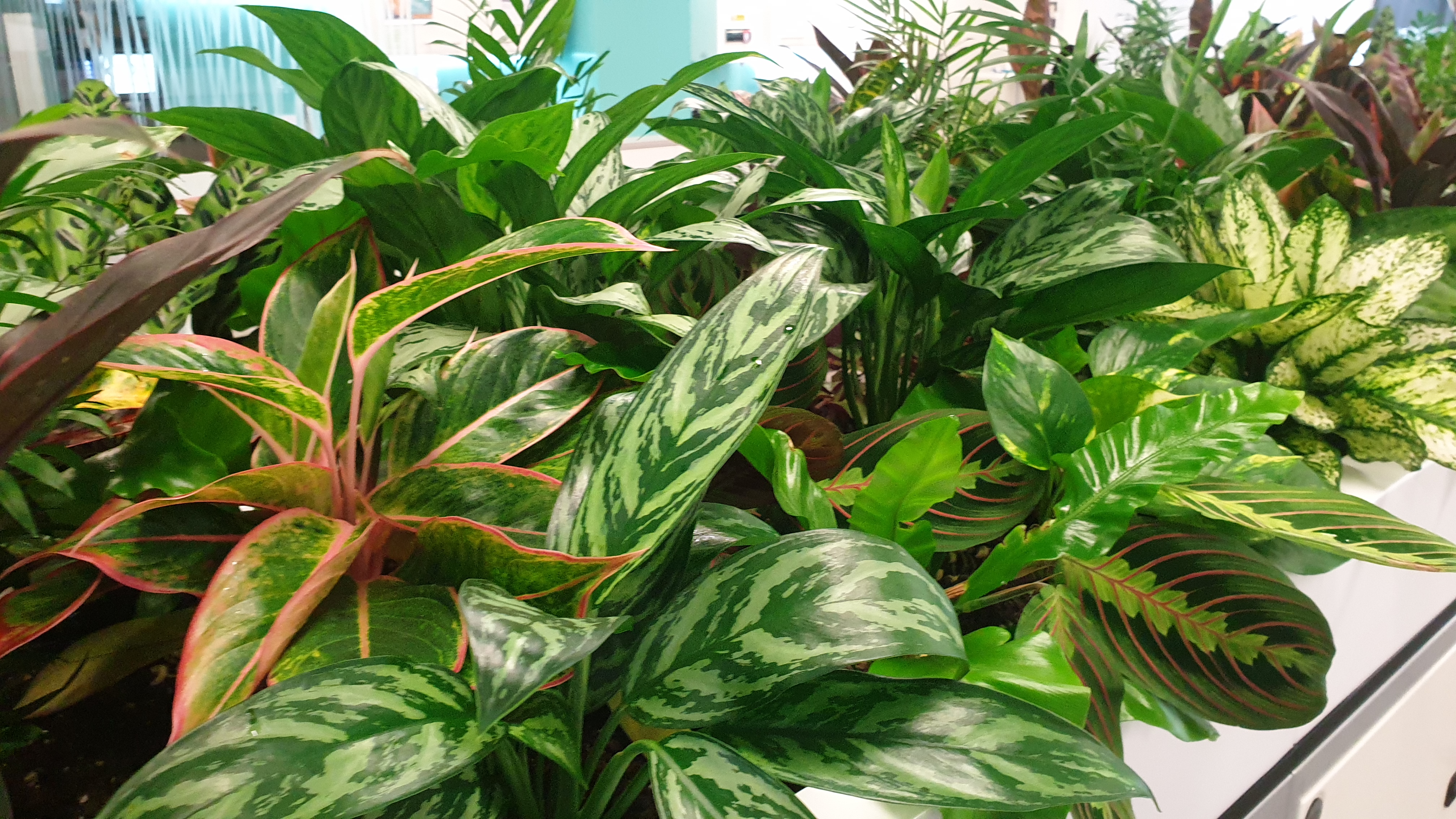
    Over the last few years, office designers have specified cabinet-top planters (sometimes called furniture-based planters). They are rectangular troughs that are designed to hold several small plants – often a mixture of species.

    These planters are often rather shallow: 150mm to 200mm depth is quite common. They can look great, but they can also have some issues – especially if you have to maintain the plants in them.

    I have seen increasing numbers of this type of planting not looking their best after a relatively short time. Sometimes, this is down to having a mix of plants that are incompatible with each other. (I have a training course about that, by the way – please get in touch). However, more often, it seems to be because the planters are very shallow. Office furniture designers – get in touch with a horticulturist (me, for example) before you design your planters. Some of your work is very sub-optimal. Why do you think 150mm depth is adequate?

    Most of these planters take large numbers of small plants in a relatively small volume of growing medium. As a result, they tend get through water quite quickly. Because they are quite high (often above shoulder height), they are also tricky to water and groom.

    Vulcaponics can work very well with furniture-based planters, but even they can struggle when the planter is especially shallow.

    Most commercial interior landscaping companies have a service cycle of two weeks or more (three weeks is common in Europe). This is fine for larger, solo plants displayed in decent-sized planters. Three or even four week watering intervals are no problem, but this is a stretch for such small plants.

    It strikes me that the best way to think of these planters is as a horizontal green wall. Green walls have large volumes of small plants in a relatively small space. They work because the watering element of plant care is managed by having an irrigation system, or hydroponic set-up.

    Shallow cabinet-top planter with hydro-culture plants
    Shallow cabinet-top planter set up with hydro-culture plants
    Image by the author

    Interior landscapers: you have options

    First, you can shorten your service cycles

    This will work, but will be costly. It might make planning of service schedules quite difficult if you have a mix of 2-week and 3-week cycles.

    Second, try using more succulents and other low-water plants

    This will also work, but you will need to check to make sure the light levels are high enough.

    Next, do nothing …

    … but make sure you price in much higher plant replacement costs.

    Finally, consider using hydro-culture For this type of plant display

    This will enable you to stretch your service intervals back to three weeks. You will also solve many of the plant incompatibility issues that would arise from the species having different water requirements when grown in compost. This is the closest to a green wall in terms of care and maintenance.

    Sansevieria plants in shallow troughs

    Get in touch for advice, training or consultancy, whether you are an interior landscaper, designer or furniture supplier – I can help you get it right. Please also sign up to get my emails about my services and training programmes.

    Processing…
    Success! You're on the list.
  • Are plants in buildings really green?  The environmental impact of interior landscaping

    Are plants in buildings really green? The environmental impact of interior landscaping

    Biophilic design aims to enhance built environments by reconnecting people with nature, thereby improving well-being and productivity. However, the environmental impact of sourcing indoor plants is complex, involving resource-intensive nursery practices, transport, and peat use. Despite these concerns, greenery in buildings remains a cost-effective method of enhancing organisational efficiency.

    Plant nursery

    Biophilic design is all about creating spaces in the built environment that are healthy, happy, engaging and effective. You may know that the reason why biophilic design works is because we create spaces that allow us to rebuild connections to nature and our natural habitat. We enrich our spaces to make the lives of domesticated, ‘battery humans’ so much better. In the workplace, biophilic design can lead to better business outcomes. More productivity per kilowatt hour of energy consumed – so possibly a gain for the environment.

    A significant element of almost every biophilic design is greenery – indoor and outdoor plants displayed in a naturalistic fashion. It is easy to assume that, because live plants are being used, that they must be an environmentally-friendly addition to any building.

    But does that assumption survive scrutiny?

    Does the green part of biophilic design create a net benefit to our environment?

    Interior landscapers, the providers of office greenery, use a variety of plants in their schemes. Indoor plants tend to have their natural origins in the tropics and subtropics – places where seasonal variation is minimal (much like the insides of buildings, which also have a near constant environment. Office blocks and rainforests have more in common than you might think.) This doesn’t mean that indoor plants are sourced from the wild – that would definitely be bad for the environment. They are grown by specialists under controlled environmental conditions in nurseries. In temperate climates, the use of native species in buildings is guaranteed to fail.

    In Europe, most indoor plants are sourced from The Netherlands. Dutch growers have perfected the art of producing millions of plants using quite complex technology to regulate the light, temperature, water and plant nutrients used in their glasshouses to produce pristine crops to exacting specifications. However, this comes at a cost. The energy used to heat and light their glasshouses has to be generated somewhere. The water used for irrigation is treated with fertilizers and any left over has to be recycled and re-treated before it finds its way back into the environment.

    Tropical plants in a nursery in the Netherlands
    Interior landscape plants at a Dutch nursery (image from Koberg bv)

    Over the last few years, the Dutch nursery industry has significantly reduced its inputs, with a significant reduction in the impact it has on the wider environment, but let’s not shy away from the fact that nursery production is a resource-consuming industry.

    Another impact on the environment comes from the substrates used to grow the plants. Peat is still used (and not just in Europe). Even where it is no-longer extracted from fragile habitats, its extraction can lead to significant greenhouse gas emissions. As the peat dries out and oxidizes, it releases carbon dioxide. This carbon dioxide is, essentially, a fossil fuel. It was originally taken out of the atmosphere thousands of years ago by the mosses and sedges alive at the time.

    Fortunately, peat is being used less and more sustainable substrates are now being used, such as coir, composted green waste and even volcanic minerals (vulcaponics).

    Vulcaponic substrate
    Vulcaponic substrate

    Once the plants have been produced, they need to be transported to the buildings where they are going to be installed. Hundreds of trucks burn diesel fuel transporting plants from the Netherlands to all over Europe and beyond.

    What about other countries?

    In North America, plant production is rather less intensive. In the major growing areas of Florida and California, plants are grown more-or-less outdoors under polythene and heavy shade cloth. The energy inputs are significantly less than in Europe, but other inputs, such as pesticides tend to be higher.

    Plants grown under heavy shade in a US plant nursery
    Plants in a US nursery under heavy shade (image by Matt Kostelnick)

    Here, as in Europe, plants need to be transported across an entire continent. Large, climate-controlled trucks drive thousands of kilometres to deliver plants from Florida to Montreal and all places in between and sometimes, plants are even transported by air.

    Air transport container loaded with plants
    Air transport container loaded with plants (image by Matt Kostelnick)

    Many plants used by interior landscapers in Europe also spend some of their lives growing in fields in Central America before being sent to the Netherlands for finishing, and many large trees and palms used in European buildings are grown in Florida and shipped to the Netherlands for acclimation and preparation before they are then sent to their final destination.

    Florida and California are both subject to ever more extreme climate events. The Florida nursery industry has often suffered existential threats due to hurricanes, and California is frequently under severe water stress.

    There are other places in the world where indoor plants are grown. I have recently visited India, where vast office complexes are being constructed at an astonishing rate. These buildings are being constructed to the highest standards – often to high LEED and WELL buildings specifications. Biophilic design is integral to these projects, both inside the buildings and in the campus environments where so many of them are being developed.

    A typical office campus in Hyderabad, India
    An office campus in India showing the extensive outdoor greenery to provide a pleasant working environment

    In India, most of the plants used are grown locally by commercial nurseries. It is a very well developed industry, which is superficially similar to the Florida industry. Vast, heavily shaded polythene structures are used to grow exceptionally-good plants for both the retail and interior landscaping markets. Pesticide inputs are low, growing media are often locally-sourced coir-based products (essentially a waste product of coconut farming) and little, or no energy is used for lighting their nurseries. Supply chains tend to be relatively short (there are nurseries relatively close to many of the big cities), so that too is a benefit.

    Anthurium plants at a nursery in India
    Tropical plants at a Nursery in India

    However, every nursery owner that I spoke to (and it was a lot) is seriously concerned about climate change. Near Pune and Bangalore, temperatures are significantly above average, and rainfall is scarce. This is partly explained by the El Niño effect, which is near its peak, but there is no doubt that man-made climate change also has an impact.

    Water shortages are a major concern. High on the Deccan Plateau, rivers are uncommon and much irrigation water is often sourced from boreholes and stored rainwater. Groundwater is rapidly diminishing and rains are increasingly unreliable.

    Commercial plant nursery near Pune, India.  A large reservoir has been constructed to store ever-diminishing supplies of water
    Commercial plant nursery near Pune, India. A large reservoir (structure on the left) has been constructed to store ever-diminishing supplies of water

    The seemingly insatiable desire for indoor plants in India, due to the rapidly developing commercial real estate market, is threatened by changes happening to the environment right now.

    Reasons to be cheerful

    I don’t want to be too gloomy, though. Compared with other elements in the built environment (including other elements found in a biophilic space), greenery still contributes comparatively little to the environmental damage caused by commercial development (though it can be improved).

    Plants are still a high impact, low cost addition to the built environment. If they make an organization more effective, you get more output (however you choose to measure it) for every tonne of carbon dioxide (or other harmful emission) put into our environment.

    Processing…
    Success! You're on the list.

  • 350 shades of green

    350 shades of green

    Over the last three months, as spring has turned to summer, and the weather in my corner of England has been spectacular, I have been acutely aware of how the landscape has been transformed by the colour green. The green things in the landscape have also changed, from the vibrant fresh shades of new foliage, to darker greens as leaves mature, or from the deep greens of cereal crops as they begin to ripen towards yellower shades and ultimately to golden brown.

    Sensitivity

    The human eye is especially sensitive to green. The shades that we name as green fall right in the middle of the visible spectrum and extend from the citrusy yellow greens to minerally blue greens. I have been told that humans can distinguish as many as 350 shades of green (although that may be an artefact of language – how do we really define green, especially at the extremes of what might reasonably be described as green?)

    How many shades of green?

    Symbolism

    Green is a hugely symbolic colour too. Pagan religions from all over the world have symbols, such as the Green Man of North European folklore. These often represent both the power of nature and its sustenance. Green is sometimes related to magic and the presence of spirits too.

    There was even a time – within living memory – that green cars were regarded as unlucky (at least that is what my grandmother told me. She was aghast when my father bought a mint green car in the 1970s, but that might just have been a comment on his taste).

    Rosslyn Chapel Green Man – photo by Johanne McInnes. (licence CC by 3.0)

    More positively, green represents sustainability and environmental responsibility. Green also means progress. Green for go is the universal convention for traffic management and for a safe state of affairs.

    All of this symbolism can be directly linked to the colour’s ubiquity, and that is also directly related to the life giving quality of a green pigment called chlorophyll, without which, no complex life on Earth would be possible. You can almost feel the force of life coursing through green spaces in nature.

    Green workspaces

    Workplaces have been given the green light to re-open as the worst of the pandemic eases. Some have taken the opportunity to go green: plants screens and moss walls are being specified to ensure physical distancing and aid with pedestrian traffic flow.

    Other workplaces are embracing the environmental opportunities that are afforded by allowing more people to be home based (for part, or even all of the time), reducing commuting time, emissions and energy bills and being available for those that cannot work anywhere else, or for when face-to-face collaboration is unavoidable. This might even lead to a significant reduction in office space occupancy, as this article in the Guardian recently explained.

    Some are looking to a more human-centred future. Instead of offices being a place to go for all work, they might be hubs for collaborative effort: occasional places that are both sociable and productive.

    Workplace managers are going to have to consider whole new interactions of disciplines in the very near future: space, furniture, technology, connectivity, restoration and recuperation, and new approaches to managing people.  All will need repackaging to create work environments that people want to use.

    Unfortunately, a large number of workplaces are doing their best to recreate the pre-pandemic state, but with perspex and cubicles. A look at some of the FM web sites and magazines shows just how uninspiring some of these places can be. High screens, often in shades of grey, blocking not just the view of a colleague, but preventing views of the broader interior landscape or even through a window. Such spaces are, no doubt, hygienic, but they are also emotionally sterile too.

    Maybe, our new-found appreciation of nature and a greater understanding of how we, as animals, respond to the rhythms of the seasons can help us create better working environments as a result.  

    In a fragile economy, those organizations willing to invest in creating more humane working cultures will be in the best place to attract and retain eager and talented people.  Fortunately, those investments need not be huge in terms of cash and capital, but instead may require taking a little time to learn and reflect on what has been learned.

    If you would like more detailed advice on creating workspaces that are humane and effective, please get in touch.